

Breasts Against the Machine
from my scratch pad

Anyone with breasts has been frustrated at some point in a dressing room. Breasts underfill blouses or overfill bikinis; they gape the buttons of a dress shirt, disrupt the line of a dress, and show through sheer fabric. Wearing a top or a gown “properly” often requires the purchase of an entire other article of clothing (one that’s famously difficult to fit correctly). Breasts vs. clothing is an age-old conflict and a universal frustration, so much so that one of its consolations is solidarity. Size 4, 14, or 24, we are all — under fluorescent lights, with discarded clothes piling up on chairs and a thin film of sweat forming on the napes of our necks — bosom buddies.
We are also, whether we know it or not, sisters in the resistance.

Time and again, manufacturers have tried to standardize women’s clothing sizes — both for pattern making and for mass production — and time and again they have been stymied by our breasts.
In the early 1900s, the first women’s clothing sizes were based on bust size (copying the method of military uniforms, which are sized to chest girth). In 1939, the Works Projects Administration funded and staffed a year-long project to measure the female body: Almost 500 workers in seven states and D.C. took 59 separate measurements of 14,698 women. The ensuing report, published by USDA statistician Ruth O’Brien in 1941, proposed a system that uses height and weight measurements because bust size was not a reliable predictor of, well, anything:
Women with bust measurements of 46 or 47 inches are no taller, on the average, than those with bust 32. Women 5 feet 9 inches tall have no larger busts, on the average, than those 5 feet tall.
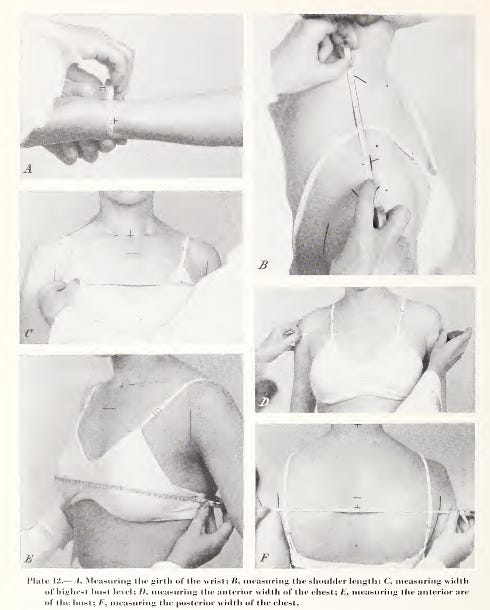
So even within the limits of this study — only white women! only women who agreed to be measured! — the bust got in the way. These same exacting-but-flawed data were used again more than a decade later by the National Bureau of Standards, which produced the even-numbered size system we know today.1 These were once again based on the bust and took as standard the hourglass shape that may have been more common in the 1950s but today describes only 22 percent of women.
My sources mentioned breasts again and again when they talked about making their own clothes: How, before they learned to sew or knit, they had to choose between wearing tents or sausage casings. How making a “full bust adjustment” allowed them to alter patterns designed for B-cups to fit their H’s. How, as the knitter Hayley Culver told me, “sweater patterns that don’t include bust darts” are “a waste of my time.”
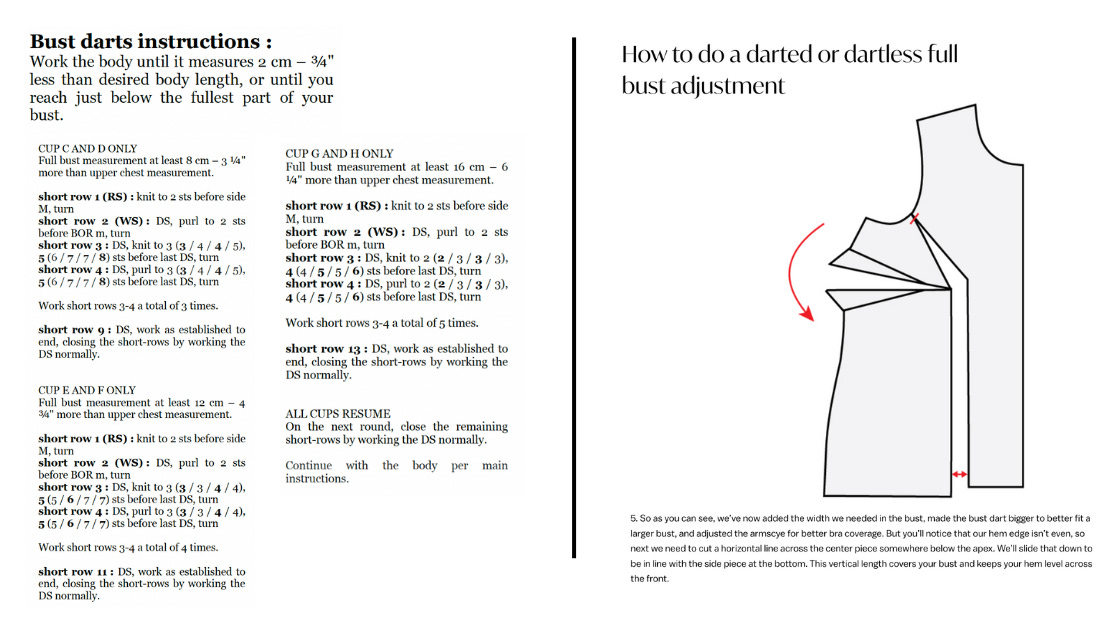
It sucks that clothes are designed for size 6 women with B cups and hourglass dimensions. Absolutely. But when you think about it, how could mass-produced clothing possibly accommodate our breasts? It’s not just that a woman my height and weight could have entirely different sized breasts, or even that a woman with my same bra size could have entirely different shaped breasts; it’s that my own breasts could be a different size depending on what day it is.
A factory system, a system that depends on mass producing great quantities of cookie-cutter clothing — as if we were shipping units or dollar bills instead of bodies — falters at the sheer variety, complexity, and unpredictability of the human breast. I kind of love that. As much as I hate that I can’t wear a store-bought button-down shirt, I love that my breasts have defeated the Gap. My breasts resist standardization; when I am tempted by fast fashion, they say “no.”
It makes perfect sense. This is the part of me that’s mine to display or keep private, whichever I choose. This is the part of me that notified me when I was hitting puberty, getting my period, going to have a baby. This is the part of me that fed my babies. When I had young children, and for a while afterward, my breasts registered someone else’s baby crying in the next room before my brain did. This is my body at its most wizard like and its most animal. At its most changeably, untameably, frustratingly, miraculously human.
Good luck with that, J. Crew.
Sort of. First a manufacturing requirement, the system was made voluntary in 1970, and by 1983 all bets were off. In a store a “12” can now legally mean anything.
Now..about trying to find a bra that fits, doesn’t ride up (my personal pet peeve) and doesn’t have to be ripped off the very second you get home… When you’ve reached the stage of really sagging, it’s just impossible.
Such great perspective - particularly love the history! . One counterintuitive point it raises is that this is also the reason it’s good that sizing is NOT standard. Most folks assume life would be better if all bra or clothing manufacturers used the exact same measurements for their clothes - finally, you’d be the same size everywhere!
But in fact the result is that a minuscule fraction of people would fit everywhere and the rest of us would fit nowhere. In the case of bras: sure there might be consistent circumference measurements - but if every bra assumed the same breast shape, height, squashiness etc, then there would no possibility to find a brand that happens to work well for YOU. Same as with garments: ok so a size 18 is now x at bust, y at waist and z at the hip. Either you fit that… or you don’t. But if another brand uses z at the waist maybe that fits YOU. Or maybe another one generally has a broader shoulder you need. Frustrating as it is, the variety provides opportunity for you to strike gold - or at least something that fits you somewhat better. One caveat: there’s no excuse for a 5XL having a 42” hip. Variety in measurements and proportions, sure, but don’t be absurdly misleading in a bid to falsely claim inclusivity.
What designers CAN do is consistently communicate the body types and proportions they’re designing for, including what we in the sewing world call “finished garment measurements”: not “what size” you should wear on your body measurements but the ACTUAL size of the garment.