

Henry David’s Hot Takes
from my scratch pad

For a couple of years (1845–47) when he was a young man, Henry David Thoreau lived by Walden Pond, in a little house he built on his friend Ralph Waldo Emerson’s land. Then he wrote a book about it. Reading Walden is like taking a long hike with your smartest, weirdest friend: Over the course of the ramble, he’s grumpy, sarcastic, earnest, delighted, despairing, inspiring, and, above all, endlessly fucking quotable.
I just barely managed to keep his prose from overwhelming my prose in last week’s essay about taking a detour in life by promising myself that I’d send you a little addendum with my favorites.

Reader, I’m a fool. Whatever else he is — philosopher, poet, naturalist — Henry David Thoreau is an entertainer, a veritable machine for producing one-liners, apt extended metaphors, and wry punchlines, all of which are the more delightful for popping up unexpectedly along the way. (“I rejoice that there are owls.”) Not only are there far too many delicious quotes to share, but gathering a basketful of them for your consumption feels wrong, the way — well —
It is a vulgar error to suppose that you have tasted huckleberries who never plucked them. A huckleberry never reaches Boston; they have not been known there since they grew on her three hills. The ambrosial and essential part of the fruit is lost with the bloom which is rubbed off in the market cart, and they become mere provender.
Mere provender. Oh.
But let’s say someone offered you a huckleberry from a market cart and you let that non-ambrosial flavor stand in for the idea of huckleberry, and give you a taste for huckleberry, until you could get yourself to the woods and pluck the real thing. That’s how I need you to think about the following quotes. I didn’t pick the funniest, crankiest, tenderest, or even most entertaining, but instead those most concerned with living deliberately, with making and thinking things from scratch.

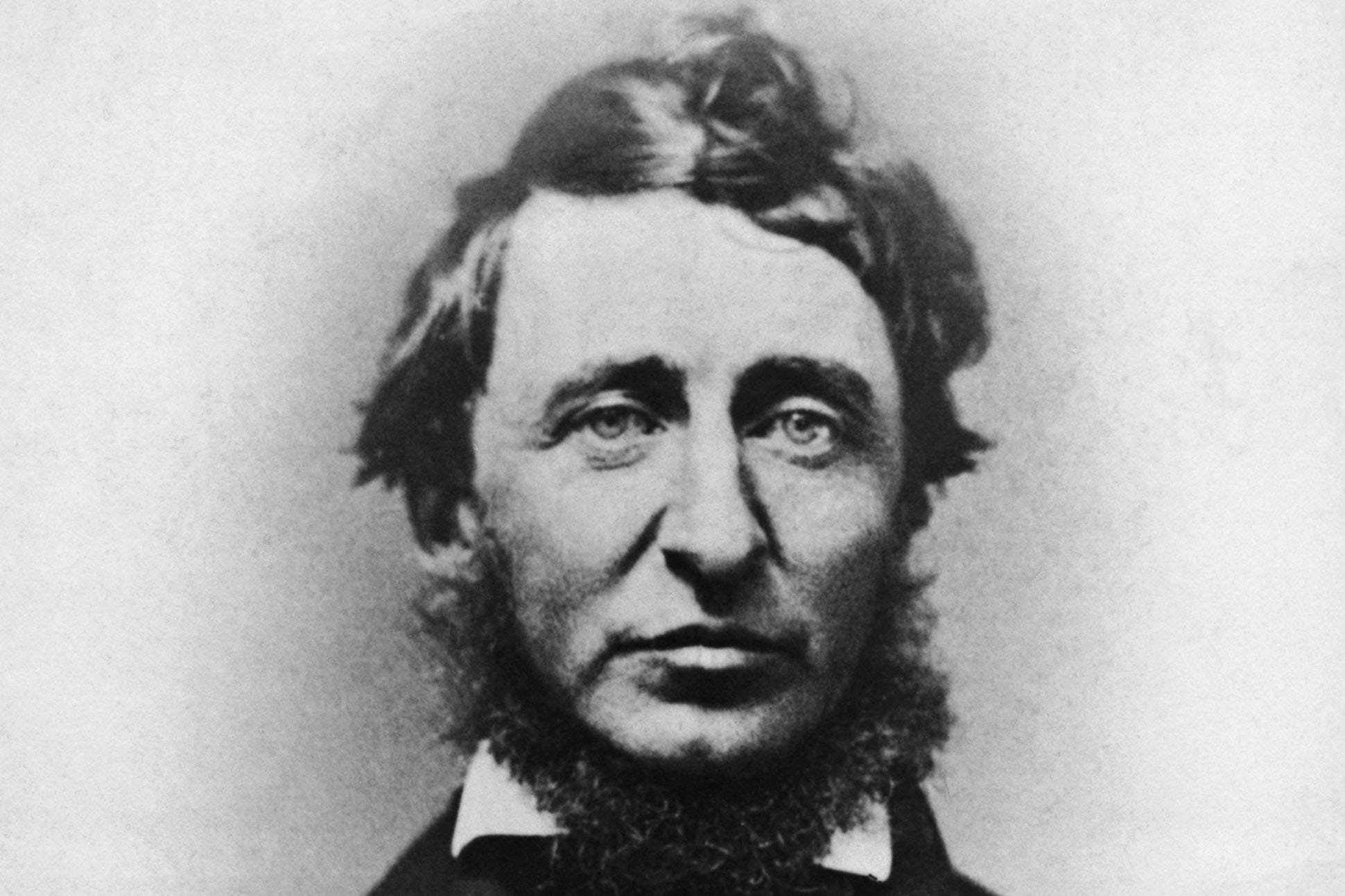
I went to the woods because I wished to live deliberately, to front only the essential facts of life, and see if I could not learn what it had to teach, and not, when I came to die, discover that I had not lived. I did not wish to live what was not life, living is so dear; nor did I wish to practice resignation, unless it was quite necessary.
SURE, THAT’S WHAT YOU WERE TAUGHT, BUT IS IT TRUE?
Thoreau craves solitude and makes fun of visitors who overstay their welcome. But you can feel his love of people in his believe that we’re capable of ignoring “what everybody echoes” and figuring out what’s real.
It is never too late to give up our prejudices. No way of thinking or doing, however ancient, can be trusted without proof. What everybody echoes or in silence passes by as true to-day may turn out to be falsehood to-morrow, mere smoke of opinion, which some had trusted for a cloud that would sprinkle fertilizing rain on their fields. What old people say you cannot do, you try and find that you can.
The surface of the earth is soft and impressible by the feet of men; and so with the paths which the mind travels. How worn and dusty, then, must be the highways of the world, how deep the ruts of tradition and conformity!
Let us settle ourselves, and work and wedge our feet downward through the mud and slush of opinion, and prejudice, and tradition, and delusion, and appearance, that alluvion which covers the globe, through Paris and London, through New York and Boston and Concord, through Church and State, through poetry and philosophy and religion, till we come to a hard bottom and rocks in place, which we can call reality, and say, This is, and no mistake.
THEY TELL US IT’S PROGRESS. [HARRUMPH.]
Thoreau lived through a technological earthquake: the arrival of the railroads, which changed commerce, labor, travel — even the idea of America. Constant construction, huge competing companies, chaos, all of it sold as inevitable. Thoreau wasn’t buying.
To do things “railroad fashion” is now the byword; and it is worth the while to be warned so often and so sincerely by any power to get off its track. There is no stopping to read the riot act, no firing over the heads of the mob, in this case. We have constructed a fate, an Atropos, that never turns aside.
Men think that it is essential that the Nation have commerce, and export ice, and talk through a telegraph, and ride thirty miles an hour, without a doubt, whether they do or not; but whether we should live like baboons or like men, is a little uncertain. If we do not get out sleepers, and forge rails, and devote days and nights to the work, but go to tinkering upon our lives to improve them, who will build railroads? And if railroads are not built, how shall we get to heaven in season? But if we stay at home and mind our business, who will want railroads? We do not ride on the railroad; it rides upon us.
Can you imagine what he’d say about A.I.?
Where is this division of labor to end? and what object does it finally serve? No doubt another may also think for me; but it is not therefore desirable that he should do so to the exclusion of my thinking for myself.
WAIT — DO YOU REALLY NEED THAT?
Thoreau made a point of not offering his guests food, and of seeing how sparse a diet he could live on. Abstemiousness is not my thing. But I love how he hates the social expectation that you constantly acquire new furniture and wear new clothes.
My greatest skill has been to want but little.
No man ever stood the lower in my estimation for having a patch in his clothes; yet I am sure that there is greater anxiety, commonly, to have fashionable, or at least clean and unpatched clothes, than to have a sound conscience. Often if an accident happens to a gentleman’s legs, they can be mended; but if a similar accident happens to the legs of his pantaloons, there is no help for it; for he considers, not what is truly respectable, but what is respected.
I cannot but feel compassion when I hear some trig, compact-looking man, seemingly free, all girded and ready, speak of his “furniture,” as whether it is insured or not. “But what shall I do with my furniture?”—My gay butterfly is entangled in a spider’s web then. Even those who seem for a long while not to have any, if you inquire more narrowly you will find have some stored in somebody’s barn.
A lady once offered me a mat, but as I had no room to spare within the house, nor time to spare within or without to shake it, I declined it, preferring to wipe my feet on the sod before my door. It is best to avoid the beginnings of evil.
“WORK” IS BULLSHIT
Having to acquire leads to having to earn money, which Thoreau sees as a wasteful way to spend one’s life. Anti-capitalism as common sense (yes, from a place of privilege on his friend’s property. But that doesn’t make him wrong).
The cost of a thing is the amount of what I will call life which is required to be exchanged for it, immediately or in the long run.
The farmer is endeavoring to solve the problem of a livelihood by a formula more complicated than the problem itself. To get his shoestrings he speculates in herds of cattle. With consummate skill he has set his trap with a hair spring to catch comfort and independence, and then, as he turned away, got his own leg into it.
This spending of the best part of one’s life earning money in order to enjoy a questionable liberty during the least valuable part of it reminds me of the Englishman who went to India to make a fortune first, in order that he might return to England and live the life of a poet. He should have gone up garret at once.
WORK IS A BLESSING
Real work — making things — brings you into a relationship with the earth and even the universe in a way that merely earning money does not. I’ve never read more beautiful words about hoeing, or more inspiring thoughts about a hammer.
Removing the weeds, putting fresh soil about the bean stems, and encouraging this weed which I had sown, making the yellow soil express its summer thought in bean leaves and blossoms rather than in wormwood and piper and millet grass, making the earth say beans instead of grass—this was my daily work.
Do not depend on the putty. Drive a nail home and clinch it so faithfully that you can wake up in the night and think of your work with satisfaction—a work at which you would not be ashamed to invoke the Muse. So will help you God, and so only. Every nail driven should be as another rivet in the machine of the universe, you carrying on the work.
LIVING DELIBERATELY IS OUR DAILY WORK
We must learn to reawaken and keep ourselves awake, not by mechanical aids, but by an infinite expectation of the dawn, which does not forsake us in our soundest sleep. I know of no more encouraging fact than the unquestionable ability of man to elevate his life by a conscious endeavor. It is something to be able to paint a particular picture, or to carve a statue, and so to make a few objects beautiful; but it is far more glorious to carve and paint the very atmosphere and medium through which we look, which morally we can do. To affect the quality of the day, that is the highest of arts.
OK, now, go read Walden. The huckleberries await.
“I rejoice that there are owls”. ME TOO!
Substack won’t let me share the photo in a comment, but my husband had THREE barred owls visit last night while he was sitting on our new front porch. They sat in the tree in front of him and just stared!
Formative text. I’ve accomplished much of what he preached. Wasn’t a cog in the machine and perfected the art of living within my meager means. Travel is the best “thing” I’ve had.