

Meet Letter Writer 612
from my scratch pad

Have you seen Her, the 2013 Spike Jonze movie starring Joaquin Phoenix and the voice of Scarlett Johansson? I remembered vividly its melancholy vibe and the relationship between Theodore (Phoenix) and his operating system, Samantha (Johansson). But I had forgotten, until I saw it again this week, how much it’s about the relationship between words and the self, and whether someone can write words that truly express how a stranger feels. It’s a perfect film to watch along with this week’s column. Warning: Given that it’s set in 2025 — which we now know will feature extreme AI boosterism, deep fake disinformation, and people “dating” chatbots — it’s extra super creepy. But somehow hopeful?
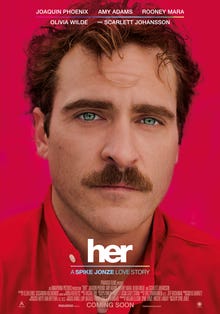
The movie opens on a closeup of Theodore’s face, thinking. Then he seems to get an idea and he starts speaking quietly, with emotion.
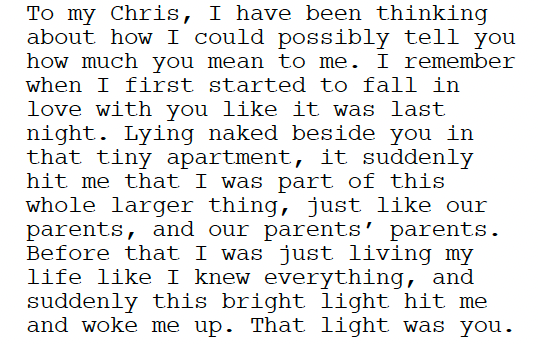
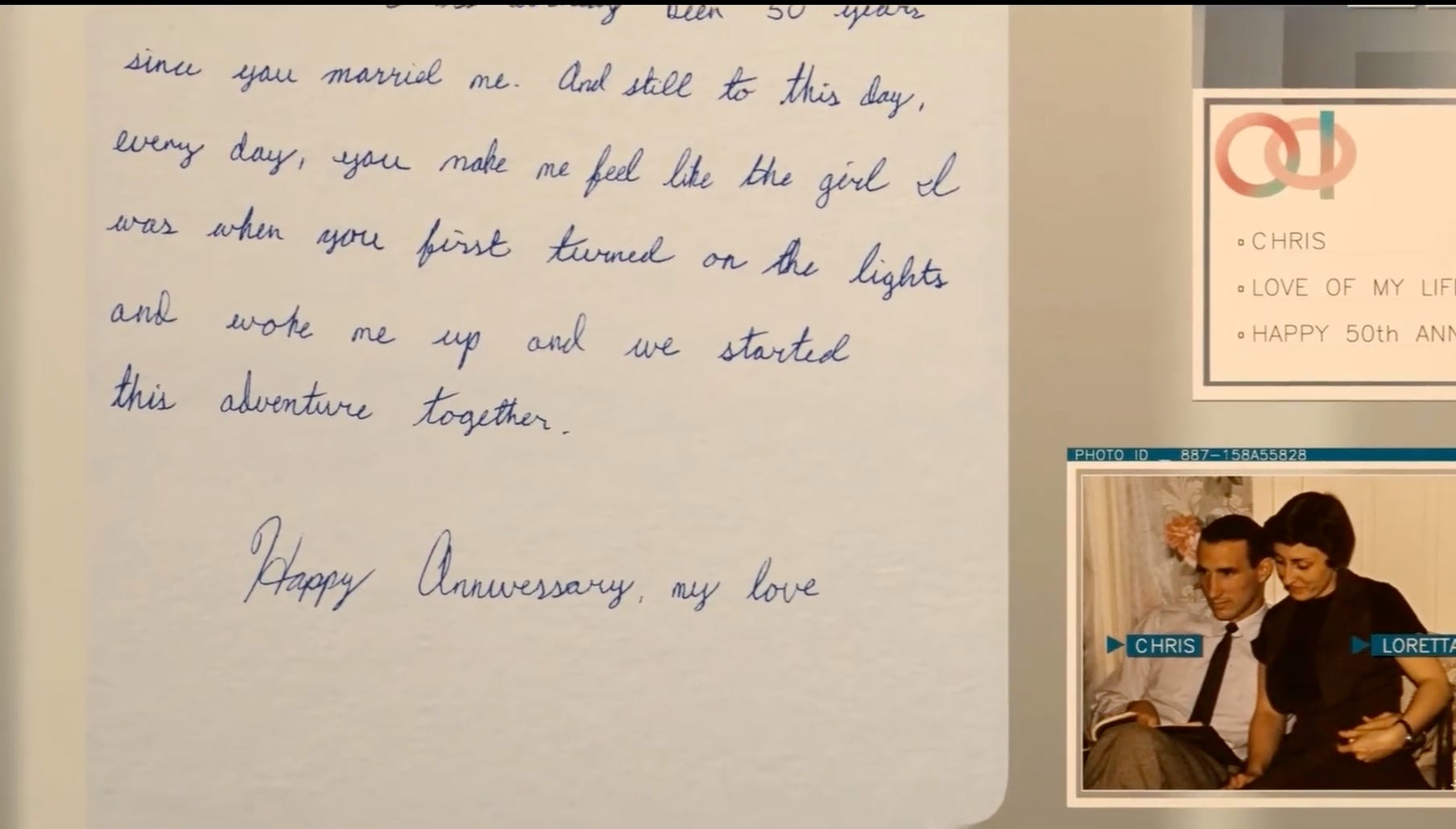
It’s not until he says, “I can’t believe it’s already been 50 years since you married me” that we suspect he might be writing the letter on behalf of someone else. “And still to this day, every day,” he continues, “you make me feel like the girl I was when you first turned on the lights and woke me up and we first started this adventure together.”
Cut to his monitor, where we see the words he is saying emerging in womanly handwriting as he writes. He’s at work. We zoom out to see his co-workers quietly dictating letters at their stations, and when he leaves, we learn he is Letter Writer 612 at an organization called BeautifulHandwrittenLetters.com.
Compared to this, the greeting cards I described, in which the messages written by a professional clearly look like they’re written by a professional, are positively guileless.
Her never suggests that Theodore’s work is sinister. He takes his job seriously, and he’s good at it — good at words, but also good at feeling feelings that inspire the words: “You know, sometimes I look at people and I make myself try and feel them as more than just a random person walking by. I imagine like how deep they’ve fallen in love or how much heartbreak they’ve all been through,” he tells his girlfriend/operating system. To write letters from other people, he uses their handwriting, but also their bullet points and their photographs. Their prompts, so to speak. He’s a gifted writer with ample source material.
We have no doubt that he feels the feelings he expresses, if only briefly. When in one scene, Samantha asks him what he did that day, he says,
“I wrote a letter from the Wilsons, in Rhode Island. Their son graduated magna cum laude from Brown. So that made me happy.”
“That’s great. You’ve written letters to him from his parents for a long time, right?”
“Yeah, that’s right, since he was 12.”
Ick. During this dialogue, by the way, Theodore is tentatively embracing a woman that Samantha has enlisted as a surrogate so that she and Theodore can “be together” physically. “Tentatively” because he’s uncomfortable with the woman’s role as stand-in for his virtual girlfriend.
In Her, Jonze grants the idea that an operating system really could achieve consciousness; the question is whether having relationships with machines instead of humans stunts our lives — whether it helps Theodore heal from his divorce or keeps him from making a new connection with a human being.
In the end, Samantha leaves, and Theodore is left to commune and commiserate with his friend Amy, whose virtual friend has also moved on. In the final scene, we see them go up to their building’s rooftop and sit together looking out over L.A. We also see, in an intercut scene, Theodore asking his computer (which now has a computer-y, rather than a Johansson-y, voice) to compose a letter of friendship and apology to his ex-wife Catherine. And then, in a reprise of the opening scene, he dictates a moving, heartfelt letter. The difference is — the hopeful part is — this time he’s writing it for himself.
Read the related essay:

Her is a movie I've been meaning to watch for a long time--it's going on the list for the holiday break.