

Barn Dance
on making big things at the speed of democracy
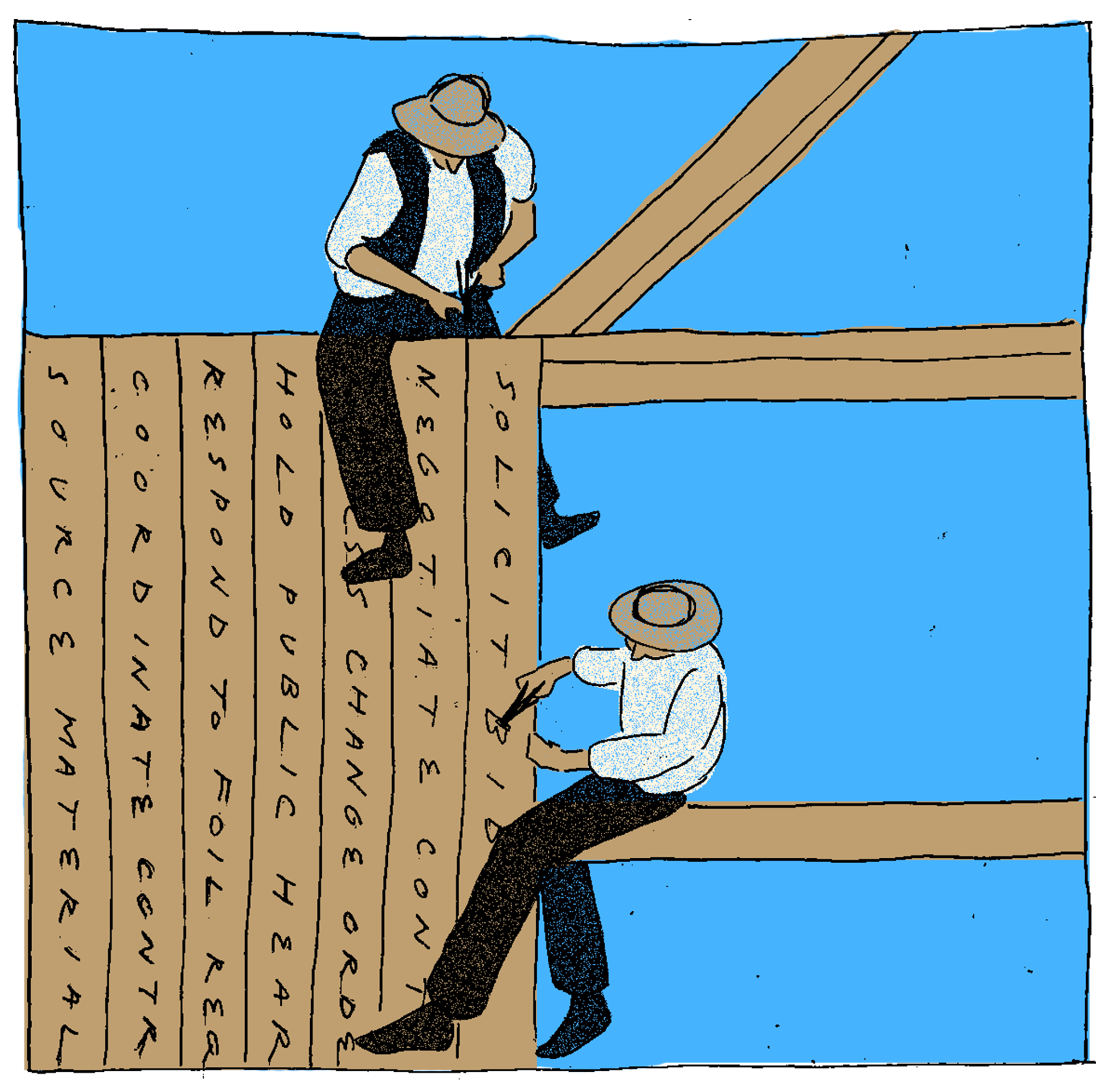
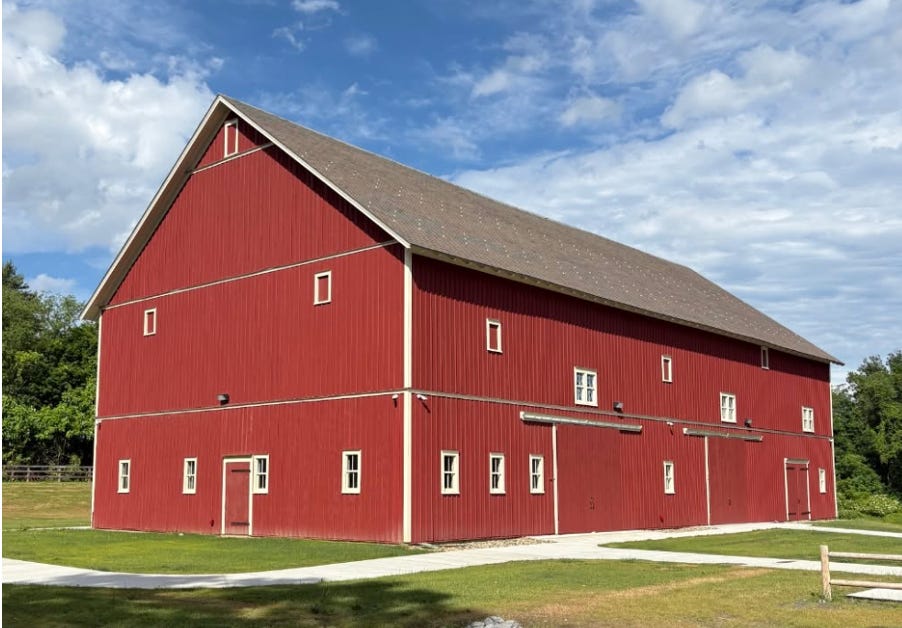
At the grand opening of the Hilton Barn — a mammoth 128-year-old structure newly outfitted for public use in New Scotland, New York — I kept thinking of that barn-raising scene in the movie Witness. You’ve seen it, right? The one where Harrison Ford proves himself useful with a hammer, Kelly McGillis lovingly pours lemonade, and Alexander Godunov smolders under his hat. And after six rousing minutes, a new barn stands proudly as the sun sets.
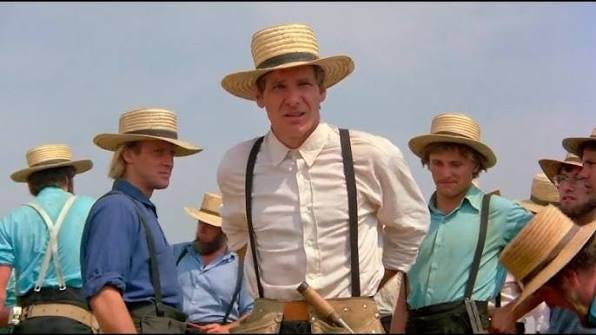
It was 100 degrees and humid at the ribbon cutting, so we mopped our brows as if we too had been hauling timber in long pants and suspenders. But other than sweat, we had little in common with the faux Amish of the movie, much less the 160 actual people who built the original barn in 1898, with timber from the farm and, for the roof, 60 tons of local slate.
The renovated barn is built of timber and slate too. But mostly this project — a new park with a skating rink and amphitheater; a parking lot and hiking trails through acres of woods; and the restored barn, which now houses public bathrooms and will soon host public events — is built of materials you can’t see or touch. Public hearings, grant applications, bid solicitations, town board votes, highway department man-hours, county, state, and federal funds. Also, with waiting: for approvals, for disbursements, for architectural plans, for bids, for state funding to thaw after the pandemic freeze, for the supply chain to unsnarl.
In other words: time. The new Captain Joseph Hilton Park is built mostly of time.
“It only took 20 years,” someone commented on a Facebook post inviting residents to the grand opening.
It took 11 years, was my first thought.
My husband was one of two town board members who devoted themselves to the project from the beginning. I had many thoughts.
For instance, Facebook Complainer, who cares how long it took? Those same 11 years might have passed with nothing at all to show for it, other than an empty space where a beautiful old structure used to stand. Instead, like magic, you get a 14-acre park, a skating rink, a sight to behold as you cycle past on the Albany County Rail Trail, and, if you go in to use a bathroom and look up at the rafters, way up, five stories up, a view that’ll make you say “Oh.”
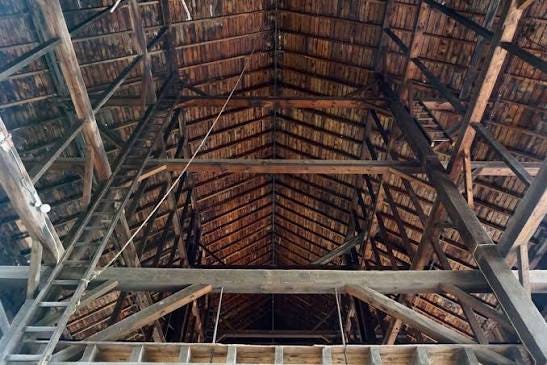
Like magic, but it wasn’t magic. It was 11 years for the people who did the work. “Going to the barn,” Adam would call out as he headed out to meet the contractor to determine whether new cut lumber was dry enough. “Barn meeting,” he would call out on his way to help decide where the skating rink would go or what kind of toilets should be installed. “I’ll be at the barn,” he would call out; something to do with the color of the siding? I tuned out, as was my privilege. He chose not to.
So, yes, I take it personally when I read Facebook comments like, “With glacial speed they moved forward.” “Wow that was fast. Not.”
You know what would have been fast? Doing nothing. Letting the barn be razed to make room for a housing development. In which case we may have had to wait only a month or two for the local historical society to decide the exact wording of the plaque that would stand in its place.
Instead, here’s what happened, at glacial speed:
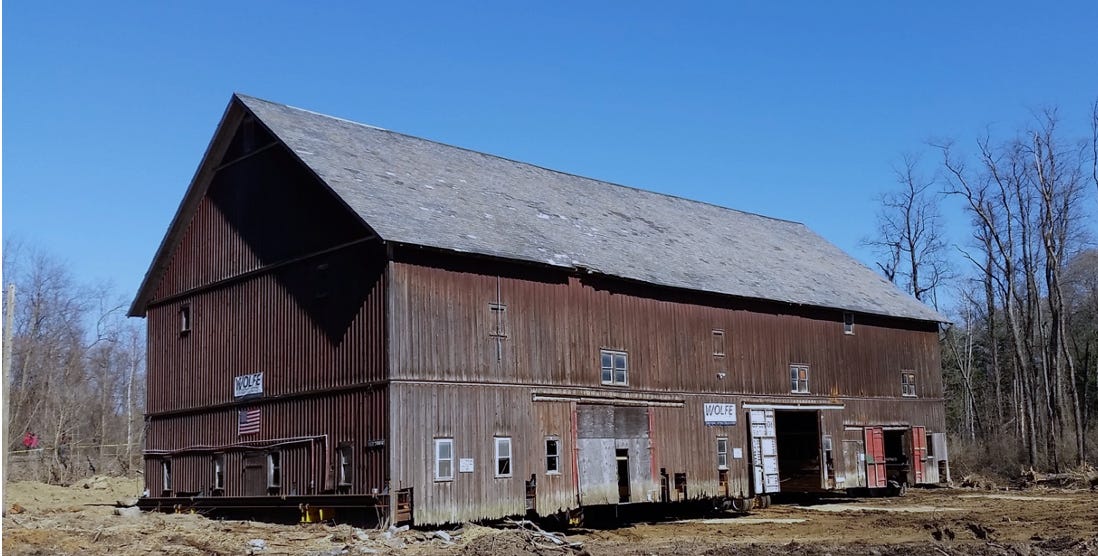
In 2014, the town learned that developers planned to tear down the barn — an emblem of the town’s rural character and a landmark of agricultural construction. At 120 feet long, 60 feet wide, and 60 feet tall, it’s also the largest post-and-beam structure in Albany County. The town managed to get the developer to hold off while they tried to figure out how to save it. Soon after my husband was elected for his first term, the town board held a special meeting to vote on moving the barn, at which point Adam (a farmer and property manager) and another board member, Bill (a civil engineer), volunteered to run the project.1
To move the barn, the town had to secure a piece of land to receive it, clear the site, find a company that could move such a large building, brace the building for its move, solicit county and state funding to pay for it, and prepare the route.
If you’ve ever been involved in a construction project, you know that every one of those tasks is the mother doll in a nesting doll of tasks. “Prepare the route” alone includes getting New York State to close the road for the day; getting the power company, the cable company, and the phone company to lower their lines so the building could cross; and directing the town’s highway department to regrade the route so the path was smooth. Inside each of those tasks, tiny babydoll tasks: phone calls, emails, meetings.
I’m bored already, and we’ve only gotten to March 2016.
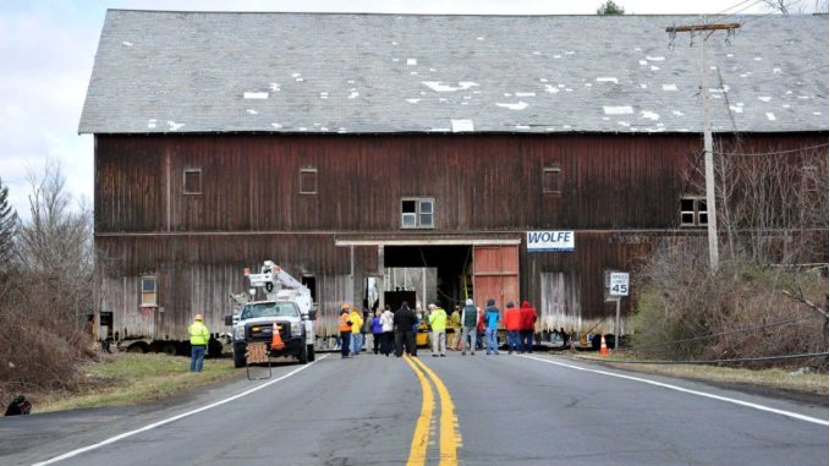
It was still winter up here when town officials and a few hardy residents bundled up to watch Wolfe House and Building Movers clamp I-beams on remote-control hydraulic dollies at the base of the building, then lift the massive, fragile barn, move it across the road, and bring it to rest alongside the Albany County Rail Trail.
The most exciting moment of the entire project proceeded at a pace of approximately one foot per minute.
After that I think it’s fair to say that most people in town lost track of the project as it inched along. It re-emerged as criticism around election time. The town had been careful to win state and federal resources to cover almost all of the barn project’s expenses, so it was hard to attack on cost.2 Instead, public grumbling expressed impatience: Why wasn’t it finished?
There are a dozen memorable scenes in Witness,3 but the barn raising is one of my favorites. No mystery why: Watching people, even fictional people, work competently and cooperatively just makes me feel better about the world. But also: I adore a movie montage.4 In real life, it takes a discouraging amount of time to achieve big things: to learn to drum, dance, grow potatoes on Mars, get in the greatest shape of your life before a boxing match. In real life, yes, barns can be raised fast,5 but not in six minutes, with a Hans Zimmer score — and not until the designing, siting, clearing land, and milling timber is done. Montages neatly edit all that dreary time right out, leaving viewers with a thrilling, undiluted sense of human possibility.
And also maybe ... a deluded understanding of how long it takes to get something done.
Imagine that Witness barn going up as a government project in a democratic society. First the notice of public hearing in the local weekly, then the public hearing. Request for bids on timber; respectful debate; vote; bid selection. Environmental impact review to determine the effect on neighboring wells. Insurers insisting on safety harnesses. Someone (Alexander Godunov, obviously) stirring up local sentiment objecting to the presence of non-Amish labor.

It sounds silly, and sometimes in real life the profusion of procedural requirements feels silly. I’m sure my husband had his frustrations with regulations and bureaucracy.6 I’m sure there are a few steps he would have liked to skip.
But we’ve seen what happens if you bypass all these annoying, time-eating layers of civic protection, and it’s a hole where the East Wing used to be, a lawsuit by the National Trust for Historic Preservation, and ballooning costs for what turns out to have been a secret no-bid contract.7
You can’t do anything in real life at montage speed, at least not anything that lasts.
Queens-raised reality TV presidents aside, city dwellers tend to grasp better the true pace of major construction. They are accustomed to watching big civic projects start and stop and they are surrounded by evidence of what the city eventually manages to accomplish in, around, and under its dense and busy streets. The majestic Moynihan Train Hall (planned starting 1990s, launch ceremony 1999, grand opening 2021), the graceful and expansive Gottesman Pool and Lasker Rink at the top of Central Park (planned starting 2015, begun 2021, completed 2025). The Q station at 96th Street, which marks the end of the Second Avenue Subway Phase 1 (groundbreaking 2007; trains running by 2017).
The Second Avenue Subway is still, famously, unfinished; Phase 2 — three more stops north to 125th Street — may or may not be completed by 2032. The line was first proposed in 1920; construction began in 1972. Some Complainers — okay, lots of Complainers — consider it a symbol of government sloth, red tape, and inefficiency.
I consider it a minor miracle. If the city gets it done in 112 years, that means literal generations of politicians and public servants persisted through obstacle after obstacle, from the Great Depression that first stalled the project through the Trump temper-tantrum that most recently did.8 Generations of public servants making phone calls, filling out forms, staying late at meetings, just to make their city a little better long into the future.
I hope I get to go to the grand opening. But if I don’t, I hope they make a killer montage.
Town councilman is a paid position, but it’s $12k a year whether you do the bare minimum (attending monthly meetings and voting on budgets) or essentially treat it as a (second) full-time job. I do not do the math on Adam’s hourly rate, just as he politely ignores my column-that-costs-more-than-it-pays.
Did some people complain about cost anyway? Do some people not bother to understand the funding? Do some people object to public projects as a matter of principle? You betcha.
I love the movie, but I do feel a little bad about that. Using a pacifist religious group as a backdrop for a movie that endorses violence is ... not cool.
Exception: montages that show people falling in love. Those are just lazy.
According to the town historian, the Hilton Barn took three days to build, which was longer than planned, apparently.
I don’t know enough to pass judgment on the law New York State just passed to allow some housing projects to skip environmental review. But it seems like the state is trying to get the balance right. Slowly, of course.
See also: a Reflecting Pool that does not currently reflect well on America.
He held up federal funding because he objected to the city’s congestion pricing.
Fun! Good writing too, no matter how much it costs.
Beautiful job on that barn, and on this related story. Thanks.