

Second Sock Syndrome
why do knitters knit together?
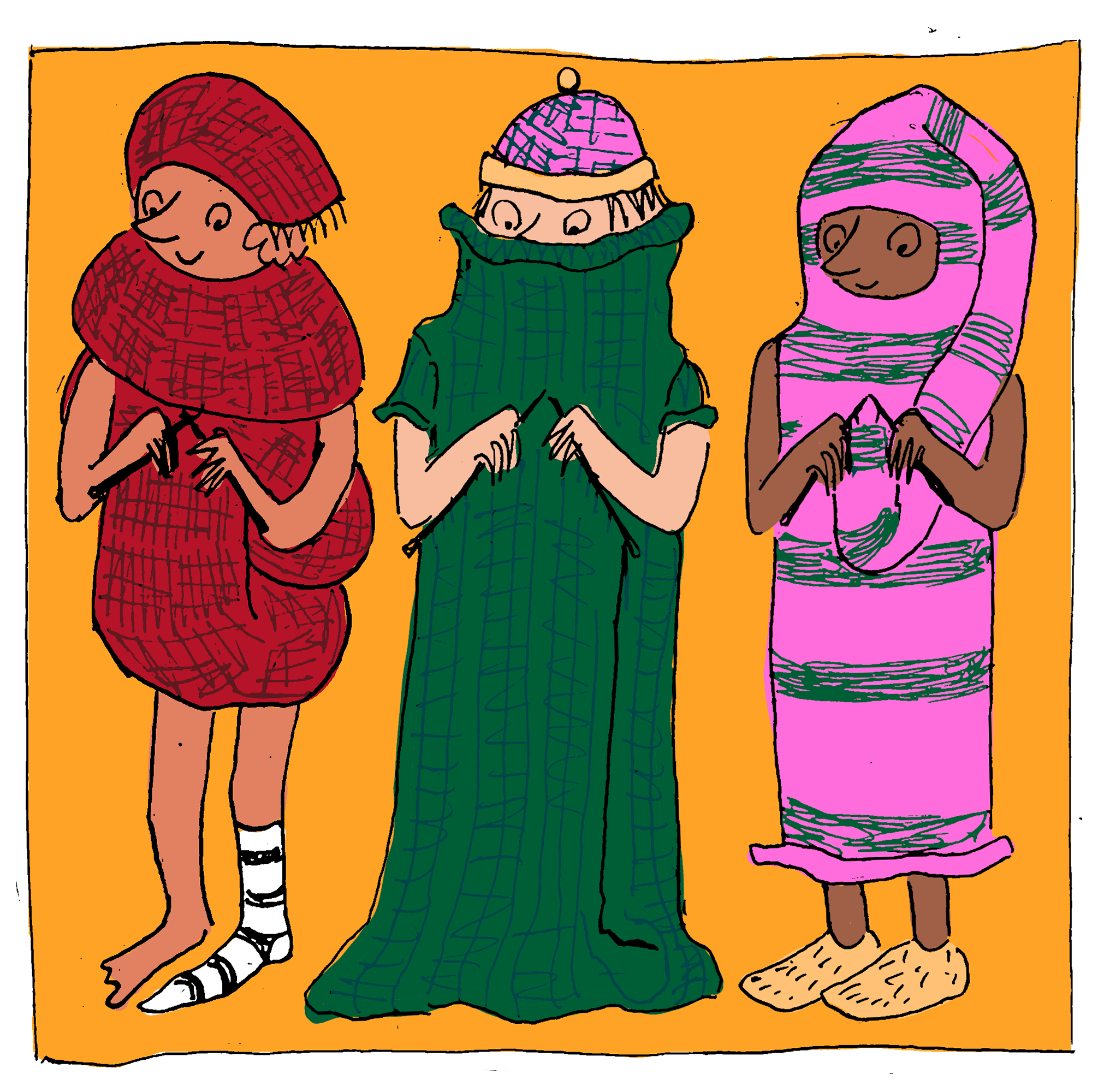
Most knitters — my sister’s friend Laura told me — identify as either process knitters (focused on mastering skills) or product knitters (focused on making specific things) or some combination of the two. But she thinks there’s a third category: knitters who really dig the gear. The yarn, of course, but also the little tools and the purpose-built bags, the needle stoppers, neck lights, wristlets designed to hold a skein. She needed another “p” word. I thought for a second.
“Paraphernalia knitters?”
That was it: my sole contribution to the 2026 TwinSet Summer Retreat in Haverford, Pa.
I don’t knit. So I could not take part in the Fiber Fashion Show or donate knitwear to Knit the Rainbow, and I wouldn’t have a clue what to put in a gift bag for the Swap Mêlée. I went to the Tubular Cast On workshop, but I wasn’t exactly there to learn.
I wanted to know why knitters gather.
I know a lot of hobby cooks; they prefer to cook alone. The home workshops I’ve admired, of woodworkers, jewelers, potters, are built for one. But the knitters I know — my sister Amy, neighbors, and friends — go off for weekends with other knitters, meet for knitting circles in the library or yarn shop or park, maybe even splurge on knitting cruises or knitting tours to the Shetlands.
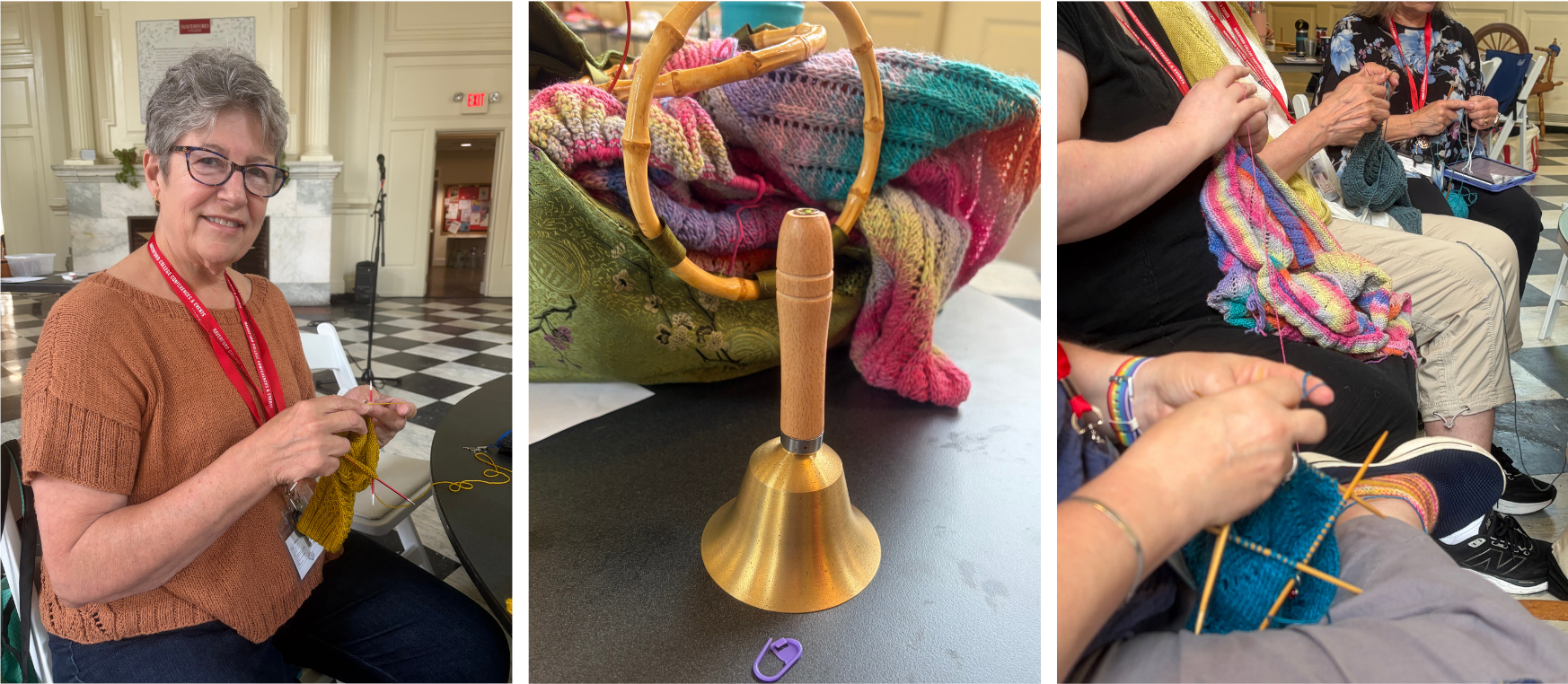
At the more affordable end of the spectrum, the TwinSet Summer Retreat was started by Jan Hamby — retired Navy, sheep farmer, wool producer, and co-host of the TwinSet Designs podcast — with eight participants. Now she caps it at 50, and it fills up fast. Knitters spend three nights in a dorm on a college campus, eat in the cafeteria, and hang out at large round tables in the main hall. They have the option of attending technique workshops throughout the weekend (Tunisian Crochet, Mosaic Knitting, Garter Tab), but the predominant activity is less formal learning and more just . . . knitting. By the time I arrived on day two, communal tables held yarn, needles, tool bags, water bottles, and printed pdfs of patterns. There was a bell you could ring if you finished a project, which happened twice while I was there (red hat, tan vest), and everyone looked up and murmured their congratulations.
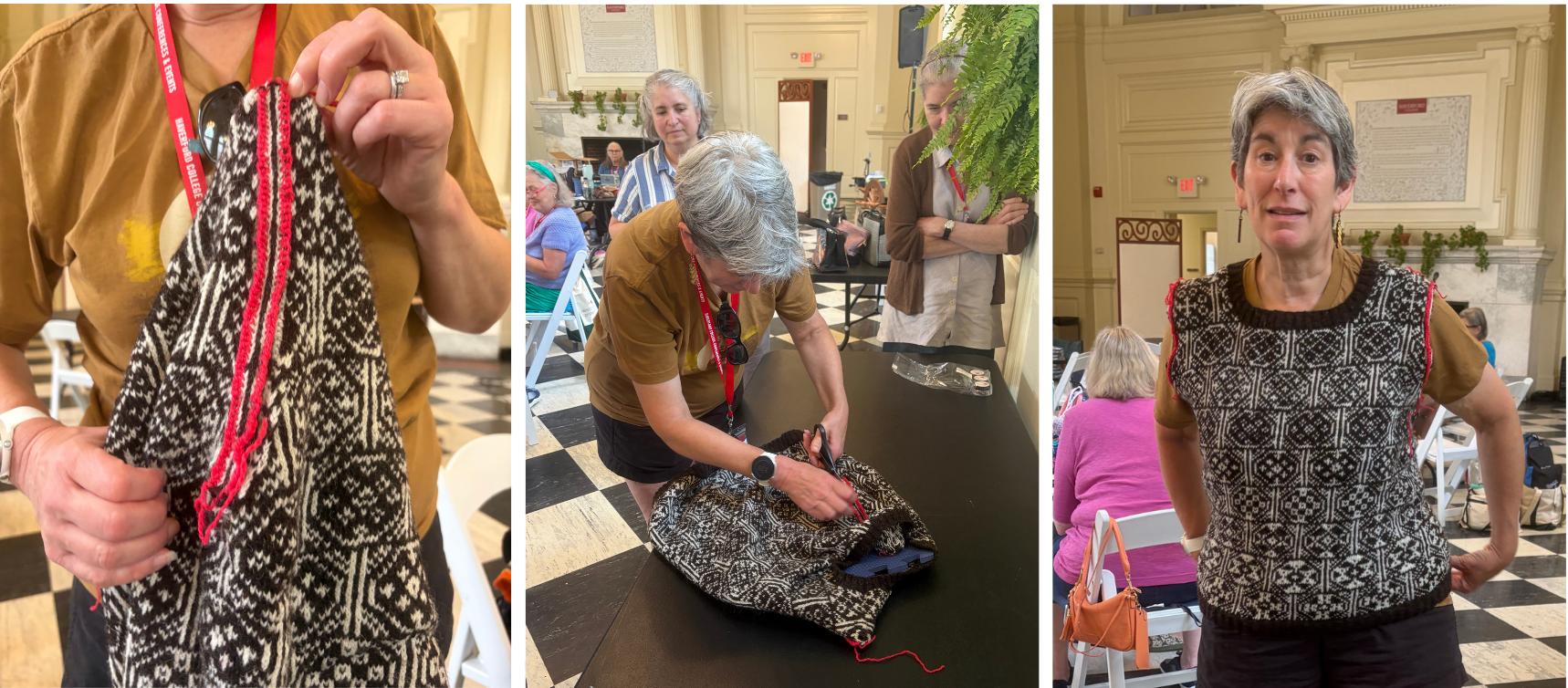
But the most dramatic moment was a steeking. Steeking is a technique where you knit a sweater as a continuous piece of fabric without armholes, include a “steek” of extra stitches where the holes will be, and then cut the steek before attaching the sleeves. To take a pair of scissors to a beautiful thing you have knitted is, apparently, an act requiring moral support. Deb, the steeker, was surrounded by fellow knitters when she took the irreversible step. Even I winced at the crunch of yarn between blades.
Steeking is one way to make armholes; it’s not the right way, just as there is no right way to knit. I knew from listening to my sister teach my daughter years ago that there are two general methods: “picking,” where the yarn stays mostly still and the needles move, and “throwing,” where the needles move less, and you twist the yarn around them.1 But within these basic styles, there are infinite variations, depending on handedness, tension, hold, and habit.2 No one knits “wrong,” and correcting other knitters, I learned, is the one absolute taboo of these gatherings. Yes, they look closely at each other’s knitting, but it’s out of curiosity, not critique.
“Okay, but who’s like queen knitter? Who’s the best?” I asked my sister afterward. (I am not a good person.) Amy took a moment before naming someone who knits fast and someone else who seems to choose hard patterns. But she ultimately shrugged: Every knitter is just different.
What they appear to have in common is the very quality she was displaying: humility. You can hear it in the knitting jargon — the language that unites knitters across generations, geographical distance, stages of learning — much of which concerns making mistakes. To “frog” is to unravel your work (rip-it, rip-it); to “tink” (“knit” spelled backward) is to undo work carefully stitch by stitch. A “lifeline” is a strand of scrap yarn you thread through your ongoing work right before you embark on a tricky stretch — so you can return to safety in case you need to frog.
Mistakes are the constant in knitting. No knitter, no matter how advanced, is beyond error. Amy is a classics professor whose family job since childhood is decoding the poorly written instructions accompanying new technology; she translates Greek and Panasonic.3 But the hardest I’ve ever seen her concentrate was trying to figure out where a piece of knitting went wrong. Beginning knitters are more perfectionist; advanced knitters learn to adjust their patterns to accommodate mistakes — or else to ignore them. One knitter said she goes by something called the “galloping horse test”; she fixes only those mistakes that could be spotted on someone riding past.
Another cluster of knitting terms expresses the rueful truth that knitters’ ambitions often exceed the bounds of the possible. “In our minds we all knit faster than in reality,” Amy’s friend Cashman said. I was told there’s such a thing as a “monogamous knitter” who knits only one project at a time before moving to another, but I did not encounter one. Everyone I spoke with had at least two projects going; the most anyone admitted to was 14. Those were the ones on needles, not just patterns “favorited” on Ravelry (the fiber arts sharing site). To “401Knit” is to stash projects in anticipation of retirement; a “SABLE” is a “stash acquisition beyond life expectancy.” Most knitters, it seems, are helpless to resist new projects, or new yarn.4
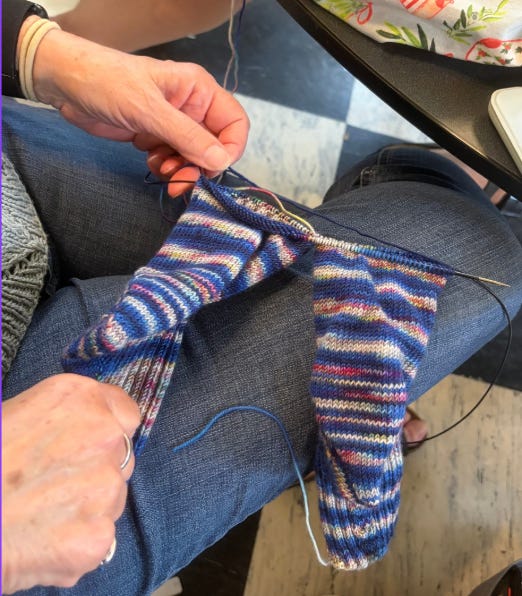
But they also acknowledge the struggle to maintain focus. Of all the projects I saw on needles — purse, lace scarf, cowl, sweater, vest, mosaic square, sunhat, Christmas stocking — the one that surprised me most was a pair of socks, knit simultaneously on the same needles. “What?!” I marveled. “Oh yes,” said the knitter. “That’s how I avoid Second Sock Syndrome,”5 the tendency to get first sock done and then . . . get distracted. Oh, how easily a WIP (work in progress) can become a UFO (unfinished object)!
Knitters freely, even gleefully, acknowledge their common flaws (yarn greed, distractibility, mistakes, mistakes, mistakes). Perhaps that’s true of painters and pianists too — you tell me — but the habit was striking. It would be tempting to look around the room and conclude that the bemused humility that suffuses both the language of knitting and the atmosphere at the retreat is related to gender. Only one of the 46 knitters present was male.6 Are women just socialized to be self-deprecating, humble, and supportive?
Maybe. Or maybe it’s the ancient7 craft itself that makes knitters modest. It starts simply enough. With two needles, a ball of yarn, a half-hour lesson, and some fine motor skills, you too can turn a continuous strand of yarn into fabric using a series of interlocking loops. But that, as every former scarf-maker knows, is just the beginning. That piece of fabric can be made to curve around a heel or shoulder, open around a neck, grip a wrist or calf. It can be lacy, ribbed, cabled. Oh, and “cabled” sounds like one thing, but it is absolutely not. There are dancing, branched, puckered, honeycomb, horseshoe, ascending tulip, floating snake, and fishtail cables, to name the few that fit comfortably within this sentence. We haven’t even gotten to color work. Venture any distance into the infinitely varied and magnificently complex craft of knitting and you will find your manual and mental dexterity deeply challenged. Knitting is no less than applied mathematics and engineering, involving angles and slopes, rates of increase and decrease, parametric equations, hyperbolic planes.8
Got all that?9 Okay, now sometimes do it without looking.
Knitting demands respect. And knitters do too — not for themselves, but for the craft. Last year, an infamous video on Hank Green’s SciShow characterized knitting as more art than science, a source of sweaters and socks whose workings were a mystery until physicists showed up to take an interest in it. Hoo boy.10
I watched three different videos, with hundreds of thousands of views, responding to the episode’s errors and tone. It’s fair to say that knitters are tired of the perception of what they do as being “women’s work” (pejorative) suitable to occupy the hours and hands of rocking-chair grandmas (extra pejorative). As fiber artist Evie Schwartz explains, “It has become difficult to separate the trivialization of knitting and the systemic devaluation of women.”
Maybe that’s why knitters seek the company of other knitters. What a comfort to knit beside other people who glance over and see not a woman fidgeting but someone undertaking the challenge of two-color brioche or German short rows.11 What a comfort to know that if you make a mistake — when you make a mistake — sure, someone might be able to advise you. But everyone will be able to sympathize.
Because there is no such thing as a perfect knitter.
Know a knitter who would enjoy this essay?
Many thanks to Jan Hamby for welcoming me to the party.
As usual with knitting, the situation is more complex than I thought. There’s also “lever,” “Eastern,” and “Portuguese”— where the yarn goes around your neck as you knit. I’m sure there are more.
It’s “whatever your fingers like,” says Amy (a picker). When she taught River, our nephew, to knit, he didn’t follow her lead exactly but “whatever he was doing was working, so we just went with it and called it the River Technique.”
“Amy, help!” was the traditional Christmas morning chorus.
Ruth told me, “Knitting is one hobby and yarn collecting is another hobby and sometimes they intersect.”
A related condition is Second Sleeve Syndrome, a.k.a. Sleeve Island. As my daughter explains it, “Bro, I already did a sleeve. I have to do another?” She says all second socks and sleeves take longer than firsts.
I asked Jan about this, and she said, in the greatest unintentional (?) burn in arson history, that she certainly thought men were capable of knitting. Other knitters chimed in that you do see men on Ravelry, disproportionately as creators and sellers of patterns (the implication being that they tended both to monetize the craft and to show off). My own theory is simpler. Since the craft has been designated female, it’s sexism that keeps boys and men from trying it or doing it in public, and sexism that keeps male knitters from wanting to join predominantly female groups. The men’s knitting retreats I found create a safe space by excluding women entirely. Needless to say, the TwinSet Summer Retreat is open to all.
Since my sister is a classicist, I feel funny saying “ancient” about something so recent. The earliest dated double-needled knit artifact: a sock from 11th to 13th century Egypt. (Just the one.)
If you’re wondering why I don’t knit, even though my sister and my daughter are both great knitters and patient teachers, it’s because I am afraid of math. There, I said it. Just barely escaped high school calculus with a B and then breathed a big sigh of never again.
Yes, I am aware that pattern makers figure it out for you, but following a pattern involves a whole additional set of skills.
He has since (sort of) apologized, and the video has been removed.
No, I do not know what those are, but they sound hard. True to form, Amy said that a knitter’s Mount Everest would be different for every person because every knitter has different strengths and weaknesses blah blah blah.
I love this! I do want to encourage you if you're interested, because I knit along quite happily and I am terrible at math (I once barely passed a math class and then immediately tested into the class below it). All I can make reliably are hats, scarves and blankets but it's still enjoyable and I'm not trying to be the best. As you found, there really is no best in knitting.
What a great article! Thanks, Kate!
I love the addition of paraphernilia knitter. And I'll add that there is a collective noun for knitters -- a kindness. This was coined by Paula Emons-Fuessle, now deceased, beloved host of 'The Knitting Pipeline' podcast for many years.
No one's stash is ever STABLE...its either growing or we're working hard to shrink it (I say curate it). And I've heard the acronym more commonly as SABLE. There are also those of us with the joy of never facing SABLE because we have younger family who have grown to love the craft -- our stash is no longer SABLE, it's legacy!