

“Better” and the Baguette
King Arthur Baking School and the pleasure of improvement
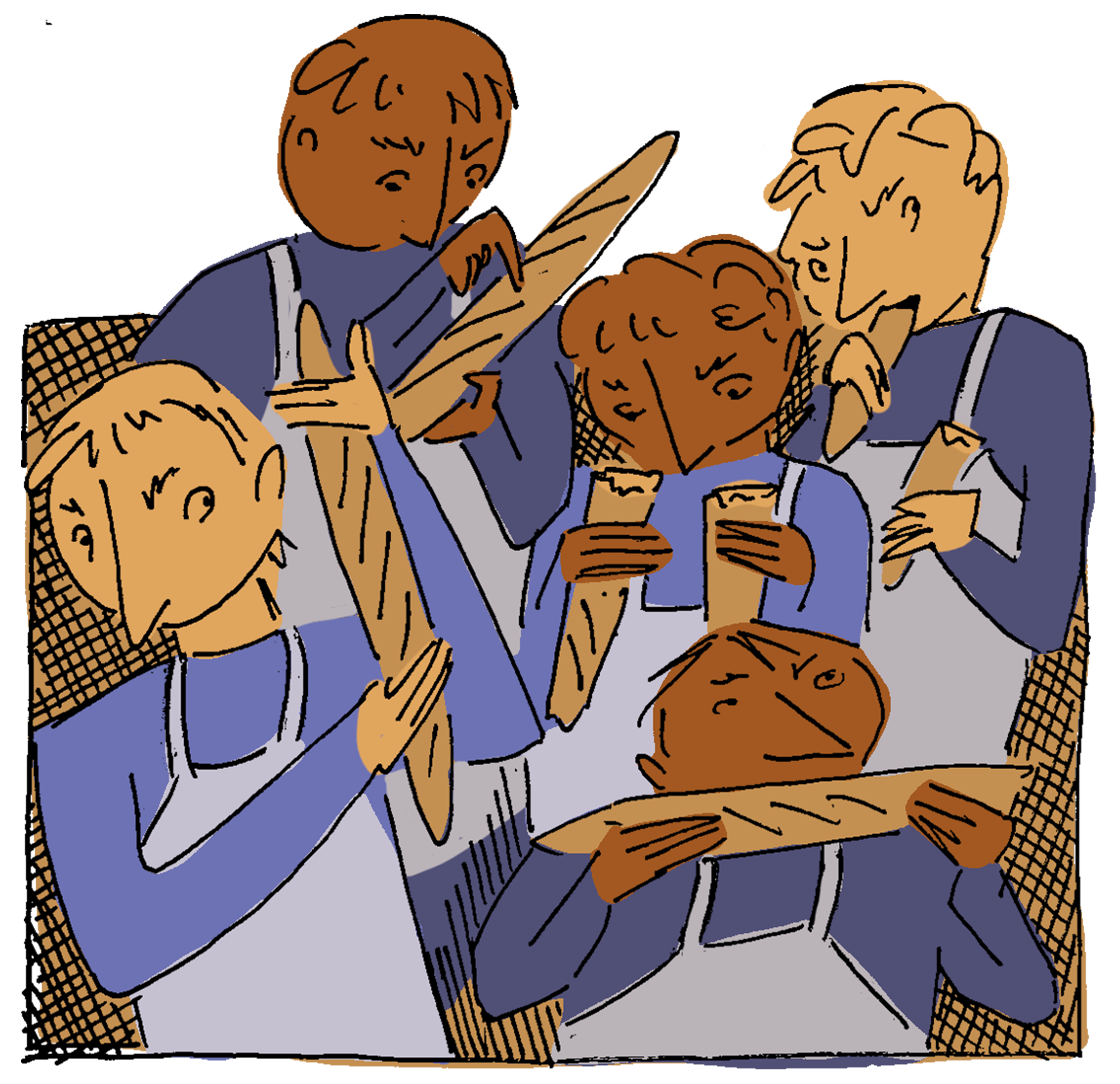
When I told my husband that I was going to take “Beauty and the Baguette” for my first-ever class at King Arthur Baking School, he protested, “But you already make baguettes!”
Yes, I said. Exactly. That’s how I know how much I don’t know.
I do love being a beginner, adding a new skill to my weird secret personal resume.1 But more than that, I love knowing how to do a thing and then learning to do it a little better.
What, I ask you — dear bakers, knitters, sewists, painters, woodworkers, writers, dancers, cooks — dear denizens of the kingdom of scratch — what is more satisfying than that?
The first thing our teacher, Ryan Salerno, told us was that the only way to improve was to make baguettes constantly — make them every week — make 1,000 baguettes. More than once over the course of our four-hour class, he reminded us, “Practice makes better.”
Thus the word perfect was both conscientiously banished and silently invoked. Wasn’t the quest for a perfect, artfully scored, dark-golden-crusted, airy-textured baguette the reason we were here?
There were 16 of us. To judge from our round-the-room introductions, we spanned a wide spectrum of proficiency. Several home bakers were comfortable with cake but regarded the baguette as their Everest; two chefs wanted to expand their bread-making skills; a few vacationers had no experience at all. One guy told us that his wife did the baking in their house, even grinding her own grains for homemade bread. “But,” he added gravely, “I don’t like it.”
I said I had made sourdough baguettes for years but never really learned to shape them, so they turned out kind of like . . . I twisted my arms into a dramatic, frozen Flamenco.
The truth was I had gotten I-already-make-baguettes lazy. Haphazard shaping was just one symptom. I never learned to score them properly with a razor to control the outward spread of the loaf as it bakes. I never bothered to use my baking tiles or preheat the oven for the minimum 45 minutes required to make it hot enough. I often forgot to use my spray bottle to steam up the oven when the loaves went in, even though I understood steam is necessary for good color, rise, and crunch.
Given all that, maybe I should have told my husband that, actually, no, I did not make baguettes. What I made was perfectly edible sourdough bread in the general shape of a baguette. This is what I knew in my heart and what I had come to class to fix.
I started baking bread in the early 90s, just out of college, after my not-yet husband asked me if I wanted a bread machine, the current craze in kitchen appliances. I said sure but first I want to try making bread myself. It turned out that making bread is both easy and enchantingly cheap. There’s a half pound of flour in each of my sourdough baguettes, which works out to about 42 cents. Even if I figured in electricity and equipment, I doubt I could make one cost a dollar.
Then, too, bread is magic, more magical even than soup. With soup making, a motley collection of ingredients transforms into a single dish; chaos resolves into coherence. With bread making, an inedible mass of flour and water becomes a completely new being. From primordial goo to form and sustenance — it’s the magic of creation itself.
So no, I did not get a bread machine. I had discovered a godlike power; why would I cede it to the Zojirushi BBCC-S15?
Instead, we bought a chest freezer, because I started baking in quantity. When the kids were growing up, we always had focaccia, sandwich bread, and baguettes on hand; and sometimes rye bread and challah too. We mostly still do. But each bread has evolved over the years, according to my dissatisfactions, my desire to inch forward toward perfection. Bread baking is easy, to begin with, but the more you know, the more you know all the different elements you can alter, the improvements you can make. My first sandwich bread was dense, so I learned to boost its strength (and thus its lightness) with high-gluten flour. It dried out too quickly, so I adopted a technique from Japanese milk bread for a moister crumb. I’m still trying to figure out how to prevent air pockets from forming just beneath the crust.
Much of what I learned about baking I learned from King Arthur Baking Company, the Vermont-based center of all things flour. It was founded in Boston in 1790 as a flour importer; it began milling flour from American wheat in the 1820s. By the time I learned about it, in the early 1990s, the company had launched a mail-order catalog full of recipes and published its beginner-friendly 200th Anniversary Cookbook. I quickly became devoted to both, and was therefore slightly miffed when everyone else learned about King Arthur Flour in 2020. During the pandemic, sales jumped 2,000 percent year over year2 and the company’s Baker’s Hotline — a free resource launched in 1993 — was flooded with questions from brand-new, and newly home-bound, bakers.
I’ve never called the hotline, but I do check the King Arthur website3 whenever I am about to bake something new. I can’t think of another institution that inspires in me the same level of allegiance; I am constitutionally disloyal. But King Arthur has never let me down, in its products or its principles.4 So when I walked into the Baking School5 for my first class, 30-some years after I started baking bread from scratch with King Arthur’s guidance, I felt both like I’d reached the holy land and that I was home at last.
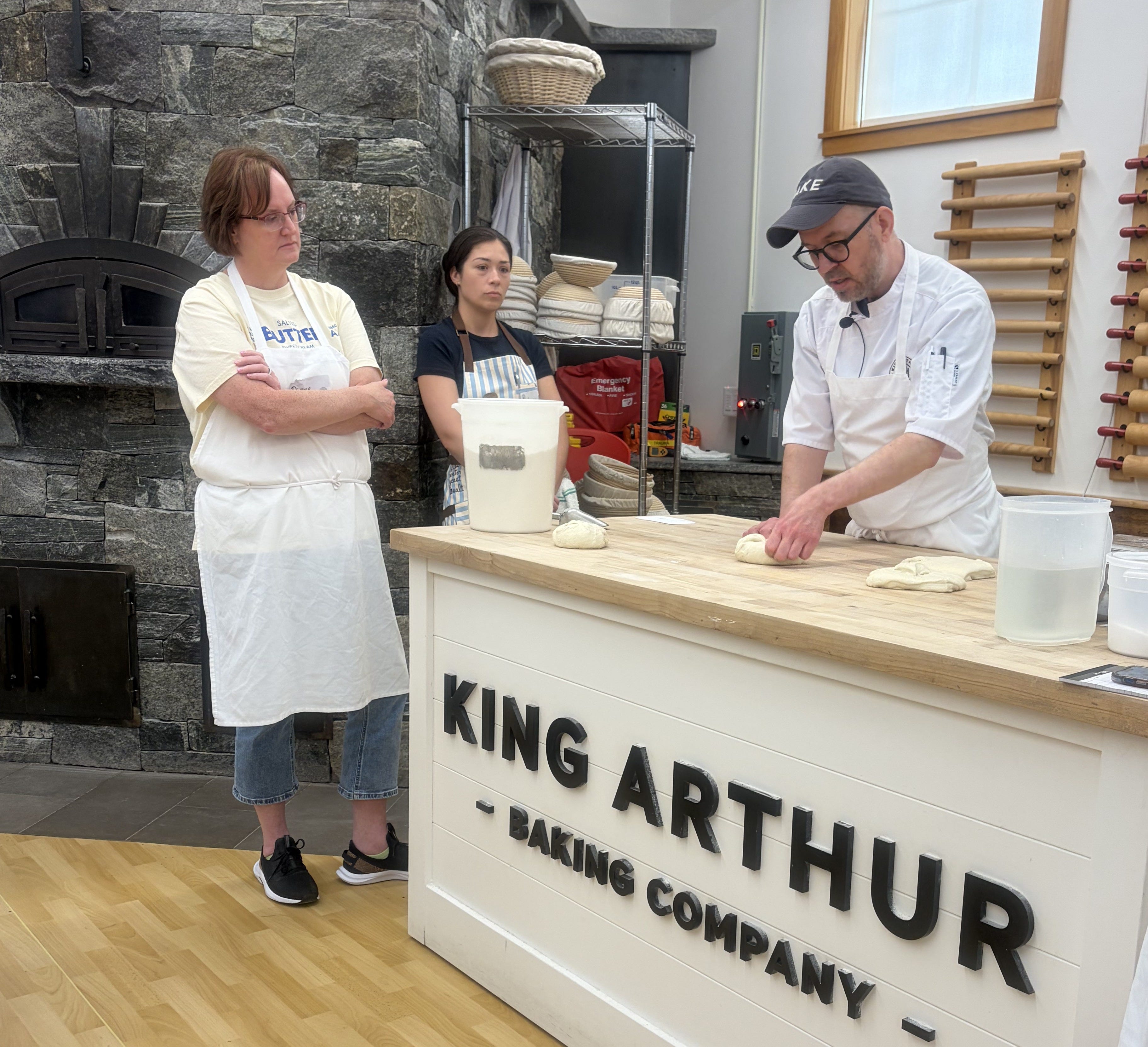
Our teacher was a professional baker who used to dispense care and advice on the Baker’s Hotline; his pedagogic mode was precise instruction paired with unflagging positivity. At every stage — mixing, folding, pre-shaping, shaping — each one of us was doing great.
At first I found this frustrating; I wanted to know whose attempt was better and whose was worse, so I could see where I stood. But eventually I realized that Ryan’s insistence that we all had done well and would do better next time — that we all both knew and did not know how to make baguettes — brought us together. Me, the guy next to me who handled his dough so aggressively that it got stickier and stickier, the woman in front of us who makes sourdough breads to sell at a farmer’s market. We may have been at different points of knowing, but we were united in wanting to know more.
What I wanted to know — what experience had taught me to ask — was what to do when I messed up. “What if you accidentally make your baguettes too skinny?” I asked, “Can you start over?” And later: “What if you do overproof? Can you start over?” Fixing mistakes is the skill that jogs behind the original skill, like a worried parent or a Secret Service agent.
There’s no way to fix badly scored dough, though. “Don’t hesitate,” was Ryan’s advice, as we each came up to the front of class to score our first two loaves with a razor blade. “Score it like you mean it.” I tried. “That’s great,” he said, and added, to me as to most of us, “A little more vertical, a little more overlap next time.” Apparently, we were united in this respect too: We were all inclined toward the horizontal.
Maybe it’s because when you picture a perfect baguette, you picture it after it has opened out horizontally in the oven; it seems counterintuitive that vertical slits are what produces that effect.
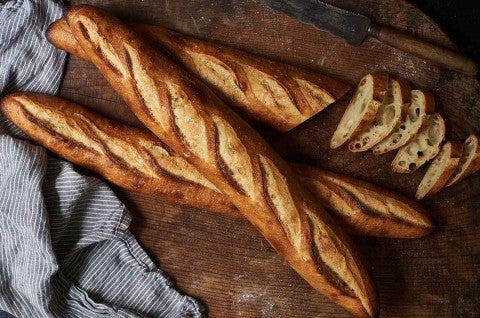
Or maybe the problem is we’re picturing not real baguettes but cartoon ones with crosswise cuts.

Whatever the reason, apparently you can listen to the teacher say, “slightly slanted vertical,” you can watch him do it over and over, and then when it’s your turn, you still want to cut across rather than down the loaf.
While our first batch of baguettes baked, Ryan showed us how to shape loaves into pain d’epi using scissors instead of a razor blade to cut successive sections of dough, which he pulled alternately to the right and left so the final loaf looks like a stalk of wheat.
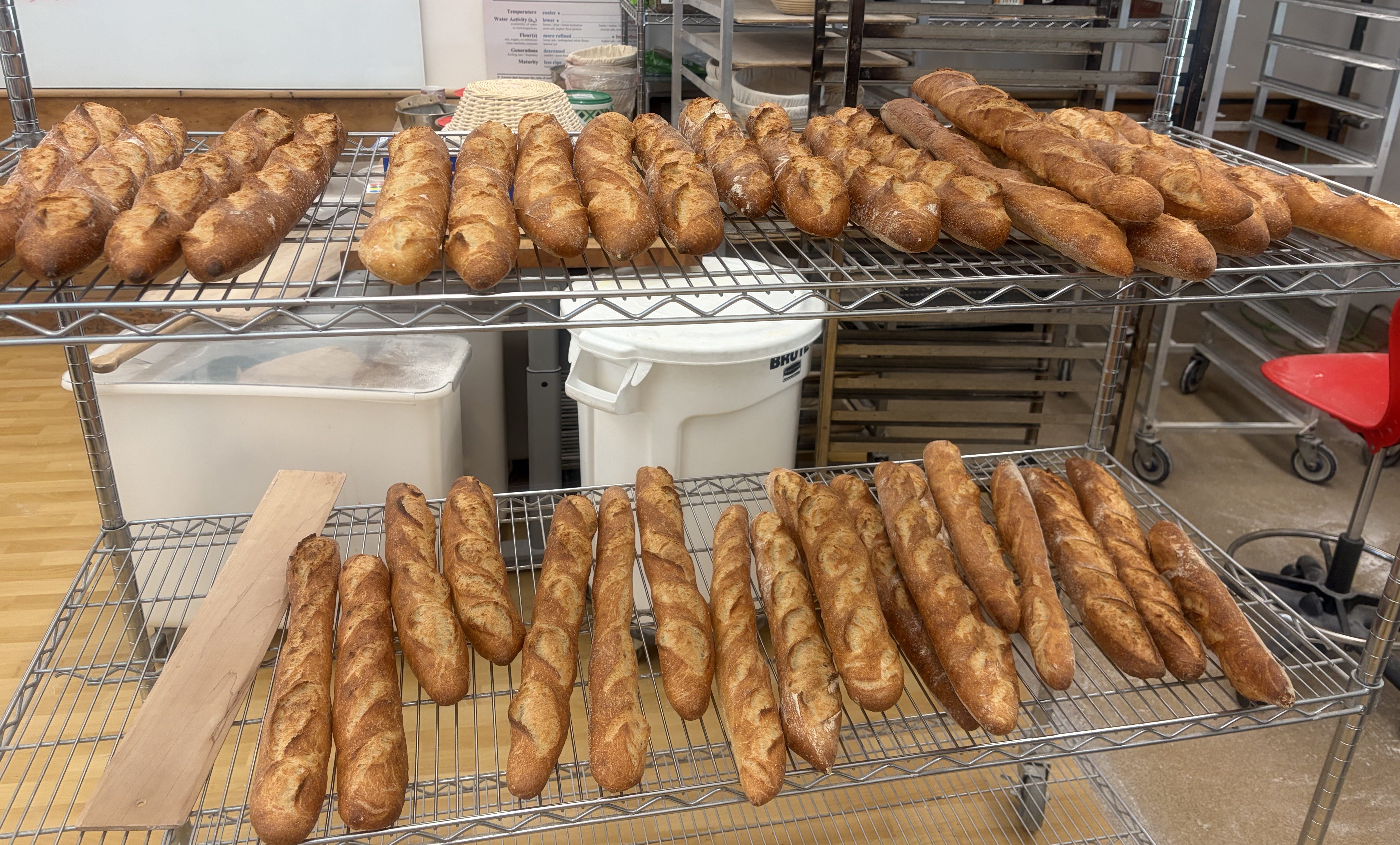
When we went up to prepare our next two loaves for the oven, we had the option of trying the pain d’epi shape instead of the typical scoring. Most people did, but I declined. I was determined to try those vertical cuts one more time.
I think I did a little better.
Just 996 loaves to go.
Hypothetical job interview: “Now it says here you can make Halloween cookies shaped like severed fingers. Tell us more.”
This was great for the company, obviously, but the pandemic baking craze meant that for a few months I could only find generic bleached flour at the supermarket. Scary times.
Take the careful testing and reliability of Cook’s Illustrated and subtract the fussiness and self-importance.
In addition to its dedication to educating and supporting home bakers, the business is employee-owned (since 2004) and, as a founding member of B Corp, officially committed to high standards of sustainability and social responsibility.
The Baking School was established in 2000. I cannot believe it took me 26 years to get there. I blame my children, the first of whom was born in 2000. Coincidence? I think not.
I'm so thrilled you had the chance to come bake with us, Kate! Ryan is a wonderful teacher and we're so lucky to have him here in VT with us. It's an honor to be a trusted resource for your baking adventures and I can't wait to hear more about your journey to beautiful baguettes. Happy baking! -Morgan
Now I'm craving BREAD!!!