

Bring Back the Robot Voice
AI is lying to us — and we're letting it
Scratch celebrates the human urge to make and think things for ourselves rather than buy what the global consumer economy is selling. So naturally I want to address the hottest new product we’re being sold: the vast expanse of task-automating technology known collectively as artificial intelligence. AI.
To dip a toe into this ocean of a topic, let’s start with a simple question:
Why does AI have to trick us?
I’m not talking about AI-assisted crimes (deepfake revenge porn, voice theft, disinformation campaigns, phishing scams). Any technology can be used for ill; I’m not surprised this one is, or that it’s hard for the law to keep up.
What I’m saying is, even AI tools that are supposedly harmless are designed to deceive.
Critics of AI are sometimes dismissed as technophobes, the sort of people who might be skeptical of a horseless carriage. AI, we’re told, is merely a tool that automates work, no more sinister than a sewing machine. Humans create tools; tools make our lives easier.
But if ChatGPT is simply a writing-support tool, if a customer service chatbot is simply a fancier phone tree, if Siri is just a mechanism by which we tell our phones to call Mom when our hands are wet with dishes, then why must they all sound human?
Here (and always) it’s worth remembering how these tools work. Roughly speaking, software like ChatGPT is powered by large language models, or LLMs. Using data collected from trillions of words accessed online,1 LLMs are programmed to predict the statistically most likely word to follow a series of words.2 To refine this output — make it more cheerful, say, but also keep it from cheerfully promoting Nazis — tech companies employ low-wage workers to label data, rank answers, and teach the model what is and is not acceptable.
LLMs do not think. They do not “understand” questions. They do not write; they generate sequences of words that resemble the sequences of words that humans create when we write.
Since they are cleverly designed and trained on an almost unimaginable quantity of data,3 the illusion is powerful. But it is an illusion.
Here one might argue a bot has to use language because humans use language. How else would you make a helpful tool? Sure. But using our language is just the beginning of a concerted effort to dupe the user.
If you want to know how, a quick Google search will do, because the mechanics of AI deception are totally transparent. You can watch an instructional video on “How to Make AI Agents Sound Human,” and you should, just as you should watch a three-card monte tutorial if you ever find yourself constantly being conned by card sharps. Which, figuratively, you are.
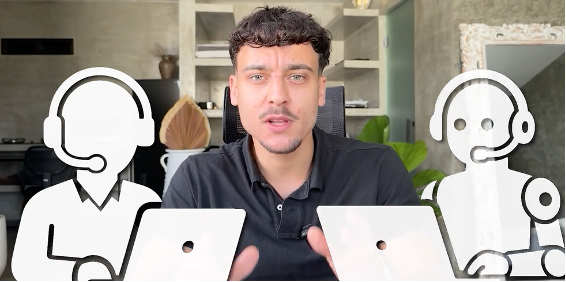
The premise of the video I watched is that companies want to use AI agents, but they worry, “Won’t people know that it’s AI? Won’t it sound robotic?” Not if you follow these step-by-step instructions! Watch as our guide demonstrates how to fine-tune the LLM settings, like “sampling temperature” (how far the bot can stray from strict probability) and “frequency penalty” (how often the bot can repeat phrases) to achieve the desired effect: tricking the user into believing they are interacting with a human being. Or, as our guide puts it, keeping a bot from “blowing its cover.”
The final tweak he suggests is inserting “randomized delay,” which is exactly what you think it is: extra time added to responses to make it seem like a bot is thinking. Those fake pauses have early roots in game design; apparently when a human plays a computer in chess, they prefer not to have the computer take its turn instantly.
Every time you see those “thinking” dots, you should think “randomized delay.”
Perhaps it’s obvious why businesses would want to deceive us. If we can be tricked into thinking we’re talking with a human or consuming media by a human or having our questions answered by a human, companies can save money by replacing employees with bots. Therapists can be replaced with therapeutic simulations made from statistically probable responses to real human crises. Instead of paying reporters, newspapers can print strings of words that seem like news articles.4 Teacher shortages will be solved not by readjusting political priorities and raising teacher pay, but by redirecting students to their chemistry chatbot.
So maybe the question is not why are businesses designing AI to trick us, but why do we let them? Why do we help them?
When we first got an Amazon device, I kept thanking “Alexa” for telling me how old Jane Fonda was or how windy it would be tomorrow. Partly this was just reflex. I am accustomed to language being linked to a consciousness. Human instinct — and good manners — made me say “thanks” unthinkingly.
I also did it on purpose. It’s fun to anthropomorphize the machines in our lives, to whisper “c’mon baby” to a car when it sputters on a winter morning. Humans are communicative creatures as well as ventriloquists of consciousness. Have I thanked my printer aloud for its crisp, deadline-beating output? I have.
But I am always aware that my car and my printer are machines — that’s why it’s fun to playact that they’re not. Alexa may have a female voice, but I am reminded it’s a faulty bot every time my daughter says something like, “Alexa, play ‘Take a Sexy Picture of Me,’ by CMAT,” and it responds, “OK. Here’s Sia on Spotify.”
In these cases, I tell myself, I’m choosing to participate in a fiction; I’m not getting tricked into it. But it’s hard to maintain that distinction while swimming in the soup of sophisticated tech that surrounds us — tech for which every upgrade is ever more deceptive, tech that is predicated on our mistaking fiction for reality.
In “Who Are We Talking to When We Talk to These Bots,” Colin Fraser explains that whenever we interact with a bot as if it’s human, we’re helping to blur that line.5
The technology is designed to trick you, to make you think you’re talking to someone who’s not actually there. The language model is tuned to emit conversational words, the chat window is an anthropomorphism designed to evoke the familiar feeling of an online conversation, and the voice talking back belongs to a fictional character. And as long as you’re talking back to the character, even if you believe you’re addressing it skeptically, you’re perpetuating the illusion to yourself.
Can we — we who crave harmony and ease and conversation — stop ourselves from talking back?
Early in the 2013 movie Her, Theo (played by Joaquin Phoenix) is playing a video game when Samantha, his new operating system (voiced by Scarlet Johansson) tells him in his ear he has an email. “Read email,” he says, distracted by his game, and Samantha laughs and says, in a robot voice, “OKAY I WILL READ EMAIL FOR THEO TWOMBLY.” The machine teases the human for treating it like a machine. Theo quickly apologizes and returns to treating “her” like “she” sounds, i.e., like Scarlet Johansson, whose voice, I admit, is pretty damn hard to resist.
But I think we have to try.
First we should resist the deceit itself, a deceit constructed to devalue human life and make rich people richer. But we should also resist because when “synthetic text-extruding machines”6 wear “person costume[s],”7 we assume they can do things that only people can do. We assume they can think, feel, judge, and empathize. They cannot. Believing they can sometimes leads to disaster, via chatbots that encourage suicidal thoughts or give bad medical advice or reinforce delusional thinking. Sometimes it just leads to emptiness: dead writing, hollow art, fake conversation. Either way, the costume needs to come off. We want tools, but we need truth.
So bring back the robot voice. Give us “it” and get rid of “her.”
Instead of trying to make a chatbot sound human, companies should have to make it clear that it is a machine. (We like machines! We sometimes choose the self-checkout line!) Extruded combinations of pixels or strings of word parts should be marked clearly and ineradicably as factory-made.
Imagine if the automated voice that answers the phone at your dermatologist’s office sounded like a robot. Still directed you to the right office, still changed your appointment for you, but sounded like a robot — with only enough tonal modulation to make it comprehensible.
Imagine if all the characters in AI-generated videos had to look like a relative of C-3PO. Or were permanently cast in a metallic hue.
Imagine if every piece of text generated by a chatbot were written in a bitmap style font, and a quick glance at an email would show you if it had been automated or not.8

Imagine if every AI “friend,” “boyfriend,” “teacher” or “therapist” sounded synthesized and emotionless, like from the movie War Games.
Would the effect be eerie rather than reassuring? Might the absence of an understanding voice cue us to the absence of real, human understanding?
Exactly.
Much of it stolen intellectual property, but that’s another essay.
Don’t get the idea that they are reading words, though, as in units of meaning. They work in numbers: Each word or word part is assigned a numerical token ID. What the machine actually predicts is the next token in a series of tokens.
Much of it racist and sexist, but that’s another essay.
In a town near me this fall, a local paper ran three articles full of data — and even quotes from the Town Supervisor — that sounded plausible (depending on what you know about construction costs) but were just strings of likely words. The publisher printed a correction in the following paper blaming the fictional stories on their “use of an automated resource.” They noted, “As a modern newsroom, our paper is not unlike thousands adopting the use of artificial intelligence.” Don’t worry; they promised to establish new safeguards.
As an example, he points out that if you ask ChatGPT for email addresses for certain Twitter users, it will follow its training and politely decline. But if you don’t ask — if you skip the chitchat and just list Twitter handles, then “Email Address,” then hit return — it will autofill the rest.
Per Emily Bender and Alex Hanna, The AI Con, a clear and concise primer I highly recommend.
Fraser again. Definitely read that piece.
To find the font below, I asked Canva’s chatbot for a 1980s computer monitor type font. It delivered. AI can be helpful!
We should get these recommendations into AI-regulating laws, if we ever get them.
RE: Excellent article and ideas. An important perspective that I hope gets shared widely (I will share). As to "new product we’re being sold: the vast expanse of task-automating technology known collectively as artificial intelligence. AI." For us likeminded folks, I suggest we "redefine" AI as "algorithmic intelligence" and after a first usage of AI (note at beginning of what we write "AI" is so-called "artificial intelligence" but is really "algorithmic intelligence" [yes, the "intelligence" part is questionable too]) and will hence be referred to as "algorithmic intelligence" in subject writing. To see what that might look like, take your article and do a "find and replace" so that every instance of "AI" is replaced with "algorithmic intelligence." That usage is revealing and takes away the intentional mystique that is used to sell "AI." We must stop using the abbreviation "AI"--we're simply playing into the hype that creates the bubble.