

Hallmark vs. Me
"innermost feelings . . . aptly expressed"
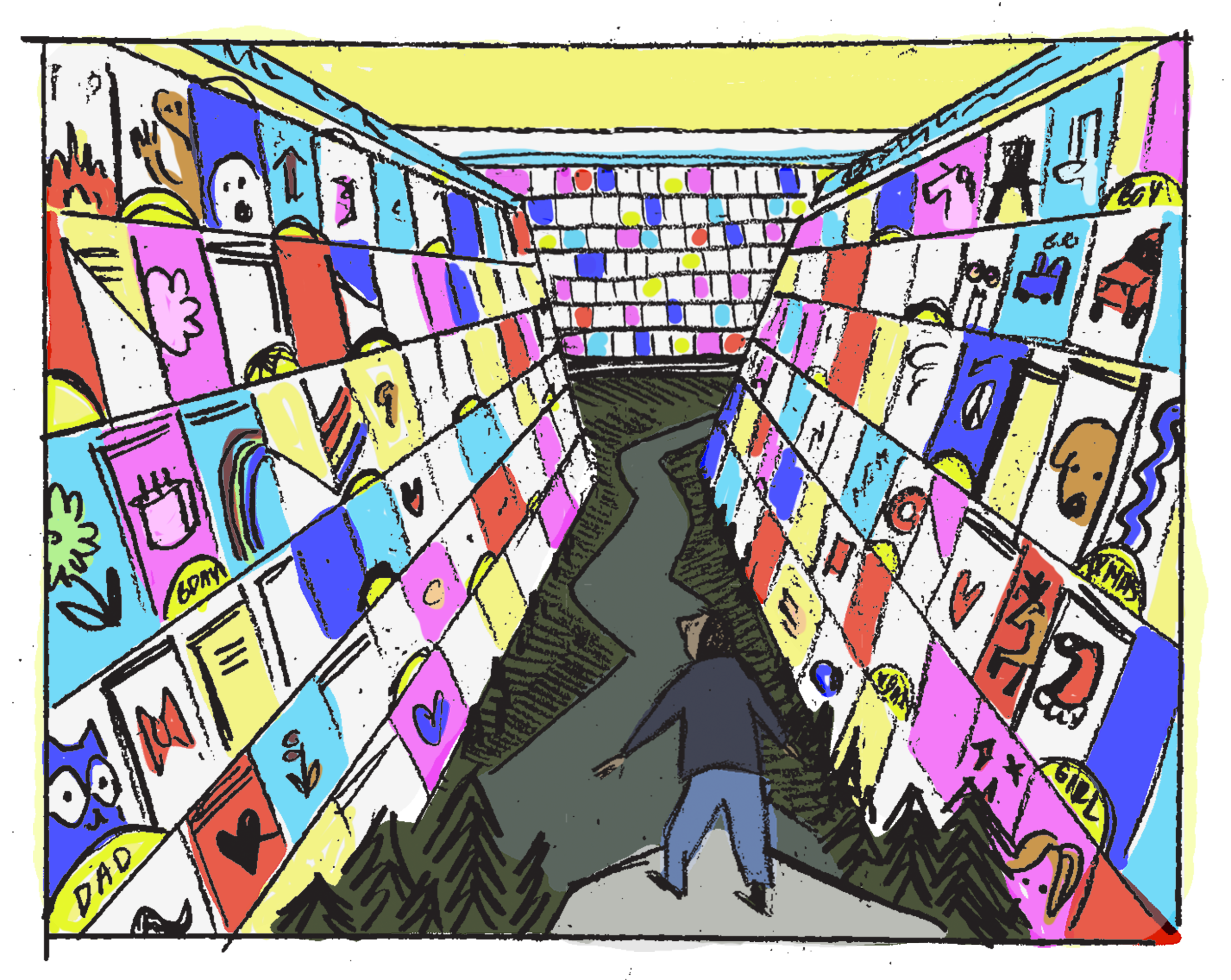
Before ChatGPT, before autofill, before Clippy the cartoon paper clip ever chirped, “It looks like you’re writing a letter. Would you like help?” the greeting card offered us the option of communicating our thoughts using someone else’s words.
Mass-produced greeting cards have been with us for more than a century.1 In 1910, the Hall brothers (J.C. and Rollie) started the company that would become Hallmark Cards, Inc., first to cash in on the postcard craze that was sweeping America, and then to sell folded cards, enveloped for privacy and purporting to contain “Your innermost feelings . . . aptly expressed.”2
Greeting cards are now a $7 billion industry in the U.S. alone, and Hallmark’s are still the top seller. You can buy them anywhere — gas station to grocery store — but I decided to go to a Hallmark Store to do something I’d never done before: buy my daughter a birthday card.
I don’t ignore her birthday; I’m just more a letter person. In fact, when I got to the store (at a mall not far from me) I was drawn to the stationery first, a few shelves of note pads, blank cards, and envelopes tucked in the back near the stockroom door.
To me, this small section looked like infinity. Infinite possible messages to infinite possible people. How could a finite inventory of prewritten cards possibly compete?
First, it takes serious retail square footage. This store featured four full aisles — nine total lengths — of greeting cards. More than 6,000, by my rough estimate.
Then you need categories. There were sections for Christmas, Halloween, and Thanksgiving. Wedding, Wedding Shower, Anniversary. Bar Mitzvah, Baptism, and Birthday. Get Well, Thank You, and Sympathy.
Hallmark can sell preprinted messages, it appears, because our lives are full of predictable holidays, rites of passage, and even relationships.
Birthday cards are, naturally,3 divided by gender and then sub-categorized by relationship: “her birthday” includes LOVE / WIFE / MOM / GRANDMA / GRANDDAUGHTER / DAUGHTER-IN-LAW / SISTER / NIECE / AUNT.
So, facing a HER BIRTHDAY / DAUGHTER array that extended beyond my visual field, I got to work — “work” in this case being not the old-fashioned thinking/writing kind but the modern American choosing/buying kind.
In theory I was supposed to be able to find among these dozens of prewritten cards something I would like to say to my daughter on the occasion of her 20th birthday. But most of the sentiments fell somewhere between slightly off and terribly wrong, not least because they tended to be addressed to the generic noun “Daughter,” as in: “Daughter, You are magic.” “Daughter, You are loved.” You know, the normal way humans speak to their female offspring.
Mother, I said to myself, good luck.
The messages inside these cards burst with superlatives, sincerity,4 and capital letters: “Loved entirely, loved unceasingly, loved exactly for who you are and the light you’ll always be.” “You are unapologetically, WONDERFULLY, and GORGEOUSLY you. You make me SO PROUD and your life gives me so much to CELEBRATE every single day.”
Despite the love I feel for Daughter, none of these quite fulfilled the Hallmark promise of reflecting my “true sentiment” “in well-chosen words.”
I pressed on.
In a 2002 Budweiser ad, a woman works her way through a greeting card aisle, reading and rejecting one by one, before finally finding the card that satisfies her. Cut to: A man buying a six-pack of Budweiser impulsively adds a cheap-looking card, unread, to his purchase. In the next scene, she reads his card across from him at dinner and declares, “It’s perfect.”
One thing this ad makes clear:5 a greeting card leads a double life. On the one hand it’s an expression of emotion, a message carefully selected to communicate something. On the other, it’s a physical token of care: The words themselves don’t matter so much as the fact of giving the card.6
We’ve all gotten cards like this. Christmas cards on which the only marks of human involvement are the recipient’s name above preprinted text and the sender’s name below it. The italic script reads “Seasons Greetings” but what the card actually says is: “You are still on my Christmas Card list.”
Which is almost nothing, but it’s not nothing. Whatever card I settled on for my daughter, I could be sure it would say, “Look, I got you a birthday card.”
Anyone who makes things from scratch has certain things they would never buy. For me, greeting cards are in that category. Maybe I could buy a funny one, but never a sincere one. Sincerity requires an honest effort to express the true self. But since my self did not compose the message on the card, sending a sincere greeting card — or rather a sincere-seeming greeting card — would feel deceptive. Posing as my innermost feelings would be . . . the decent Thursday morning effort of a staff writer in Kansas City.
I know it wouldn’t deceive anyone: It’s clearly machine-printed, not handwritten. But by standing in for my true thoughts, wouldn’t some other person’s words stand in the way of them?
That’s the idea with which Sir Philip Sidney begins his sonnet cycle Astrophil and Stella: Astrophil fruitlessly looks to other writings to express his love, but “others’ feet still seem’d like strangers in my way.” In the end, his Muse, exasperated, says, “Fool” . . . “look in thy heart and write.”
It’s not lost on me that I am quoting a poet here7 and that I, a professional writer, find it relatively easy to be sincere in words. To me, it’s simple — Fool! — just think for a few minutes, and write. But other people’s relationship to the words on the inside of these cards might be more like my relationship to the art on the outside: I would never attempt it myself. Art is for professional artists!
Perhaps greeting cards are a $7 billion industry because as a culture we’ve internalized the notion that “when you care enough to send the very best,” your own words aren’t good enough.
In the end, I bought the sole card in the category “HER BIRTHDAY / DAUGHTER / In French.” Translated it reads “May this day be full of happiness and may the whole year be gentle to your heart.”8
I chose this card because my daughter is a French major, the message was relatively restrained and therefore palatable, and — probably most important — I found it more tolerable to send a message I didn’t write in a language I don’t really speak.
Then I took la carte to the food court to add a little note of my own.
I told my daughter she’d been with me in spirit during my mission. I mused about the message and joked about the illustration (dog on a scooter, pourquois pas?). I said . . . well, other things, not from Mother to Daughter, but from me to her.
In other words, I discovered that a greeting card can lead a triple life: (1) expression, (2) act, and (3) prompt. In this way, it’s much like the holidays and rites of passage that label the aisles of cards in a Hallmark store — and organize our lives. Was my first child’s high school graduation truly important? I don’t know, but I know it prompted my husband and me to throw a party and make a speech. And I’m glad we did both.
I mailed the card from the mall post office and I left satisfied, and even a little inspired. I decided that if I send a card next year, it will include a picture drawn by me, no matter how embarassingly amateurish. Because I care enough to send the very best I can do myself.
It’s a little complicated: Also note: Esther Howland, a young Massachusetts entrepreneur, started making Valentine cards using an assembly line around 1850. Louis Prang, a Prussian-American lithographer, is credited with the first Christmas cards beginning around 1875. It was after Prang that the Greeting Card Association named its annual awards: The Louies.
Per a 1928 advertisement in Ladies Home Journal.
Not naturally. Essay on that to come.
Hallmark has accounted for the sizable subset of consumers who are suspicious of sincerity. In 1986, the company introduced a line of cards under the brand “Shoebox.” These are the “edgy” ones, as indicated by the faux-grudging tagline: “Hallmark Approved. Sorta.” I almost bought one that read “There’s just one thing to say to a DAUGHTER who’s as BEAUTIFUL and SMART as YOU on her BIRTHDAY . . . YOU’RE welcome.”
I could write a dissertation on this ad. Stay tuned for “The Card Is Empty, but the Bottle Is Full: Heteronormative Consumerism in 21st Century America.”
I don’t think we’re meant to feel sorry for this lady, who is doing both her emotional labor (by carefully choosing the perfect card) and his (by imbuing a random card with perfect significance). I think we’re supposed to recognize a contented heterosexual domestic situation in which women are women and men are men. The fact of his card shows he really does love her, in a man way. (Here, have a Bud.)
Also not lost on me: The poet is writing in the voice of a fictional poet/narrator (and his Muse) who is using the notion of sincerity as a frame for his masterwork. How sincere is that? Stay tuned for: “These Rhymes Hold My Beating Heart: The Sincerity of Artifice in Sir Philip Sidney’s Astrophil and Stella.”
“Que cette journée / soit remplié de bonheur / et que l’année tout entire / soit douce à ton coeur.”
You had me at "Sir Philip Sidney."
Thanks so much for "sharing the very best" critique of Hallmark I have ever seen.
I avoid Hallmark like the plague.
Dollar General does so much better, especially with their totally blank ones which allow full personal expression.